
📋 Summary
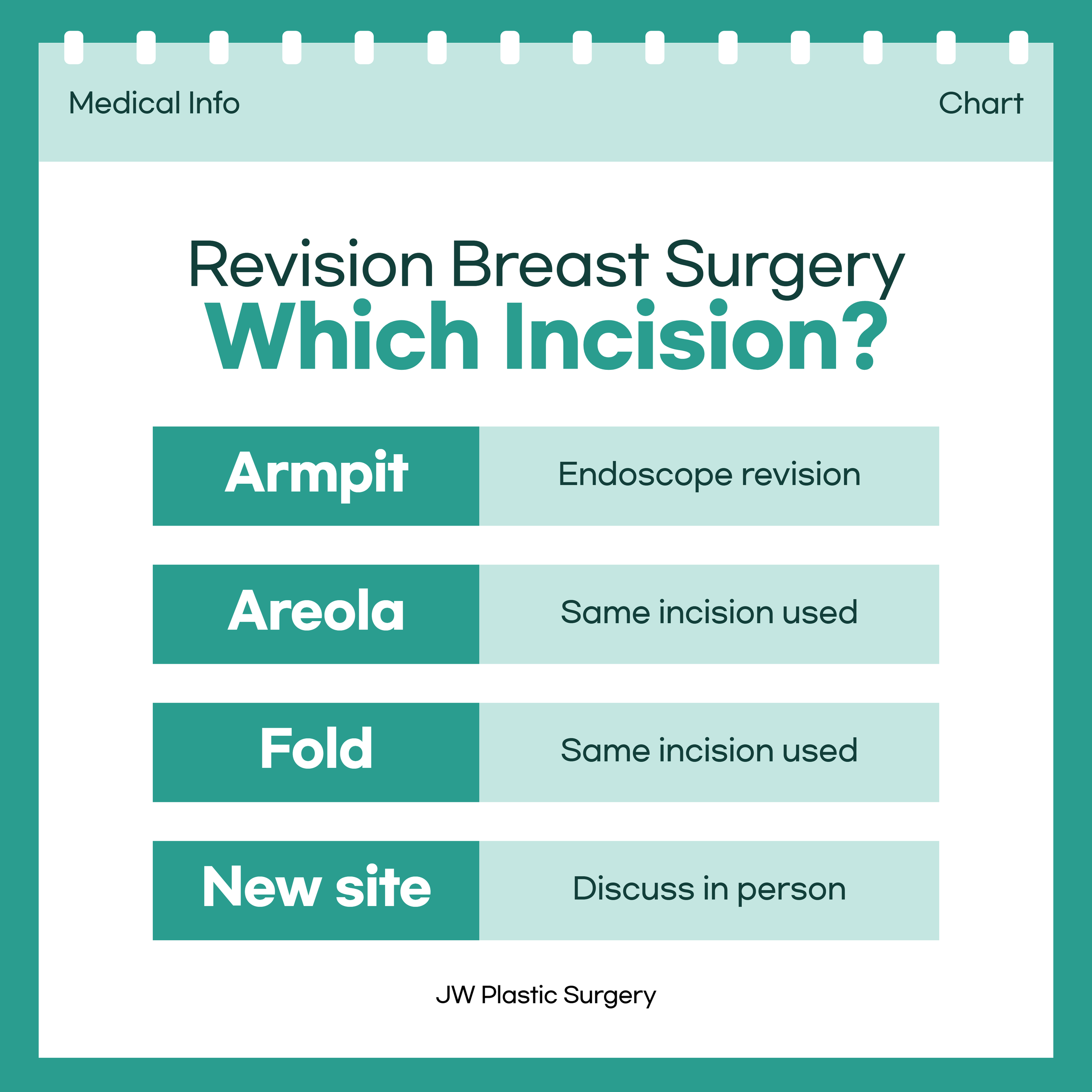
- ✅ Conclusion: At our clinic, revision breast surgery is generally performed through the incision you already have, whether it is in the armpit, at the areola or in the fold under the breast.
- ✅ Armpit: An axillary (armpit) incision can be reopened, with the work done using a full-HD endoscope, which may avoid adding an incision on the breast itself.
- ✅ Choice: The final incision depends on your first surgery, your scar concerns and your breast shape, and it is decided at your consultation.
🔍 Questions in this article
Thanks for stopping by the JW Plastic Surgery blog.
If you already have a scar from your first breast surgery, the thought of another one can leave you hesitating. It’s natural to want to know where the incision will go before you ask about anything else.
Here, we explain which incision is generally used for revision breast surgery, what each of the three sites involves, how the scars differ, and how the choice gets made.
– JW Plastic Surgery
Which Incision Does Revision Breast Surgery Use?
At our clinic, revision breast surgery generally uses the incision from your first surgery, whether that was in the armpit, at the areola or in the fold. The same site is reopened, so a separate incision may not be needed.
| First surgery | Plan |
|---|---|
| Axillary (armpit) incision | Armpit re-incision with a full-HD endoscope |
| Periareolar incision | The same periareolar incision |
| Inframammary fold incision | The same inframammary fold incision |
An axillary incision sits in a crease of the armpit. A periareolar incision runs along the edge of the areola, the darker skin around the nipple. An inframammary fold incision sits in the crease under the breast.
Since revision usually goes through one of these sites, your surgeon starts by finding out where your first incision was. If you would rather move to another site, we cover that at the end of this article.
Why the Incision Site Matters
The incision matters because revision work calls for a clear view inside the breast. Treating capsular contracture (hardening around the implant) can involve removing the capsule, the layer of scar tissue around a breast implant. Other revision work can involve widening the implant pocket or correcting the implant’s position.
For this reason, revision breast surgery has generally been done through a periareolar or inframammary fold incision. Both sites are close to the breast, and with an inframammary fold incision the inside of the breast can be seen directly with lighting. An axillary incision is farther away, so the inside of the breast can’t be seen directly from there without an endoscope.
So when a first incision was in the armpit, moving to the areola or fold could add a scar on the breast.

Revising Through an Armpit Incision
If your first incision was in the armpit, it may be possible to reopen it and do the work with a full-HD endoscope, a small camera that shows the inside of the breast on a screen. Our clinic uses endoscopic revision techniques for this approach, so an added incision at the areola or in the fold may be avoided.
| Method | Use |
|---|---|
| Capsulotomy (opening the capsule) | Widens a tight implant pocket |
| Capsulectomy (capsule removal) | Removes the whole capsule |
| Capsulorrhaphy (capsule suturing) | Narrows an oversized pocket |
| Acellular dermal matrix graft | May be used where tissue has thinned |
These methods can be done through an armpit re-incision. Which ones are combined depends on why you need revision and whether you want your implant replaced or removed.
An axillary incision also has its own considerations. This approach leaves more open space in the upper breast, so the implant needs extra care as it settles, and fluid from the pocket doesn’t drain out as easily. For axillary incision surgery, our clinic uses a surgical drain, which is generally removed within one day. Your surgeon can tell you how this applies to your revision.
Revising Through the Areola or Fold
If your first incision was at the areola or in the fold under your breast, revision can generally go through that same incision. These are the two sites revision breast surgery has traditionally used, and both sit close to the breast.
At our clinic, a new periareolar incision follows the irregular border of the areola in a zigzag pattern instead of a simple half circle. If your first incision is being reopened, your surgeon can explain how this applies to you.
An inframammary fold incision doesn’t involve the armpit, so arm and armpit discomfort may be less than with an axillary incision. It can also be useful when breast sagging (ptosis) needs correction. Our clinic generally doesn’t use a surgical drain with this incision, though your surgeon can tell you whether one may be needed for your revision.
How the Scar Differs by Site
Scars differ mainly by where they sit: in an armpit crease, along the areola border or in the fold under the breast. A scar placed in a natural crease or border tends to be easier to hide, though how yours heals can vary.
| Site | Scar |
|---|---|
| Armpit | Inside the deepest crease |
| Areola | Along the border |
| Fold | Hides more easily if the fold is deep |
In our breast surgery, we keep the incision as short as we can, because a longer incision means a longer scar. The layer under the skin is closed with dissolving stitches, and the skin surface is sealed with surgical tape, so there are generally no stitches to remove.
If your first scar is very noticeable, that can itself be a reason to consider revision breast surgery. How that scar might be handled depends on its condition, so it is worth discussing in person. Your surgeon can look at it and explain what may apply to you.
Can You Choose a Different Incision?
You may be able to, and the final choice is made together with your surgeon at your consultation. Keep in mind that moving to a new site means a new incision, in addition to the scar you already have.
| Factor | Effect |
|---|---|
| First incision | Reopening it may avoid a separate scar |
| Armpit scar worry | Areola or fold may be considered |
| Breast sagging | A fold incision can be useful |
| Fold depth | A deep fold hides a scar more easily |
If a scar in the armpit really bothers you, a periareolar or inframammary fold incision may be an option. If your breasts sag, a fold incision may also suit the correction. And if your fold is deep, a scar there can sit out of view more easily.
Your reason for revision breast surgery is part of this decision too, since common reasons such as capsular contracture, implant position and implant rupture can call for different methods. How that affects your incision varies, so your surgeon can explain it after examining you.
📌 How a consultation works
① First incision: We confirm where your first incision was
② Cause: Your surgeon checks why revision is being considered
③ Goals: You talk through replacing or removing your implant
④ Incision: Your surgeon explains which incision may fit your plan
⑤ Pre-op tests: Surgery under general anesthesia calls for a blood test, ECG and chest X-ray
📍 JW Plastic Surgery clinic information
- Address 3F-7F, 553 Samseong-ro, Gangnam-gu, Seoul (Samseong Jungang Station)
- Phone +82-2-541-5114
| Item | Detail |
|---|---|
| Hours | Mon-Fri 09:00-19:00, Sat 09:00-17:00, closed Sun and holidays |
| Website | https://www.jwbeauty.com |
Frequently Asked Questions (FAQ)
Q. My first incision was in the armpit. Will revision add a scar on my breast?
A. If your armpit incision can be reopened, an added incision at the areola or in the fold may be avoided. Your surgeon can tell you whether this applies to you.
Q. Can a periareolar incision be reused for revision breast surgery?
A. Yes, it generally can. The same goes for an inframammary fold incision.
Q. Which incision is hardest to see afterward?
A. That varies from patient to patient. An axillary incision sits inside an armpit crease, and an inframammary fold incision can hide more easily if your fold is deep.
Q. Will I need a surgical drain?
A. At our clinic, axillary incision surgery uses a surgical drain, generally removed within one day. Inframammary fold incision surgery generally doesn’t use one, though this can differ in revision.
Q. Can I just tell you which incision I want?
A. Yes, please share your preference. The final method is decided together after a full consultation.
Worry about one more scar is a fair reason to ask questions before deciding on revision breast surgery. Knowing where your first incision is and what each site involves can ease that conversation.
You can reach JW Plastic Surgery at +82-2-541-5114 to book a consultation.