
📋 Summary
- ✅ Conclusion: Before revision breast surgery, your surgeon can check your breasts with a physical exam, a 3D scanner and, when needed, breast ultrasound, and your general health is checked with pre-op tests.
- ✅ Purpose: Each check answers a different question, from how your breasts look and feel to what is happening inside them.
- ✅ Planning: The results, along with whether you’d prefer implant removal or replacement, can help shape your plan.
🔍 Questions in this article
We’re JW Plastic Surgery in Gangnam, and we wrote this for anyone weighing a revision after breast surgery.
Going back for another round of exams can feel like a lot, especially when you aren’t sure what each test is for. It’s natural to want to know what will happen before you walk in.
Here, we go through each check before revision breast surgery, what it looks at, and how the results fit together.
– JW Plastic Surgery
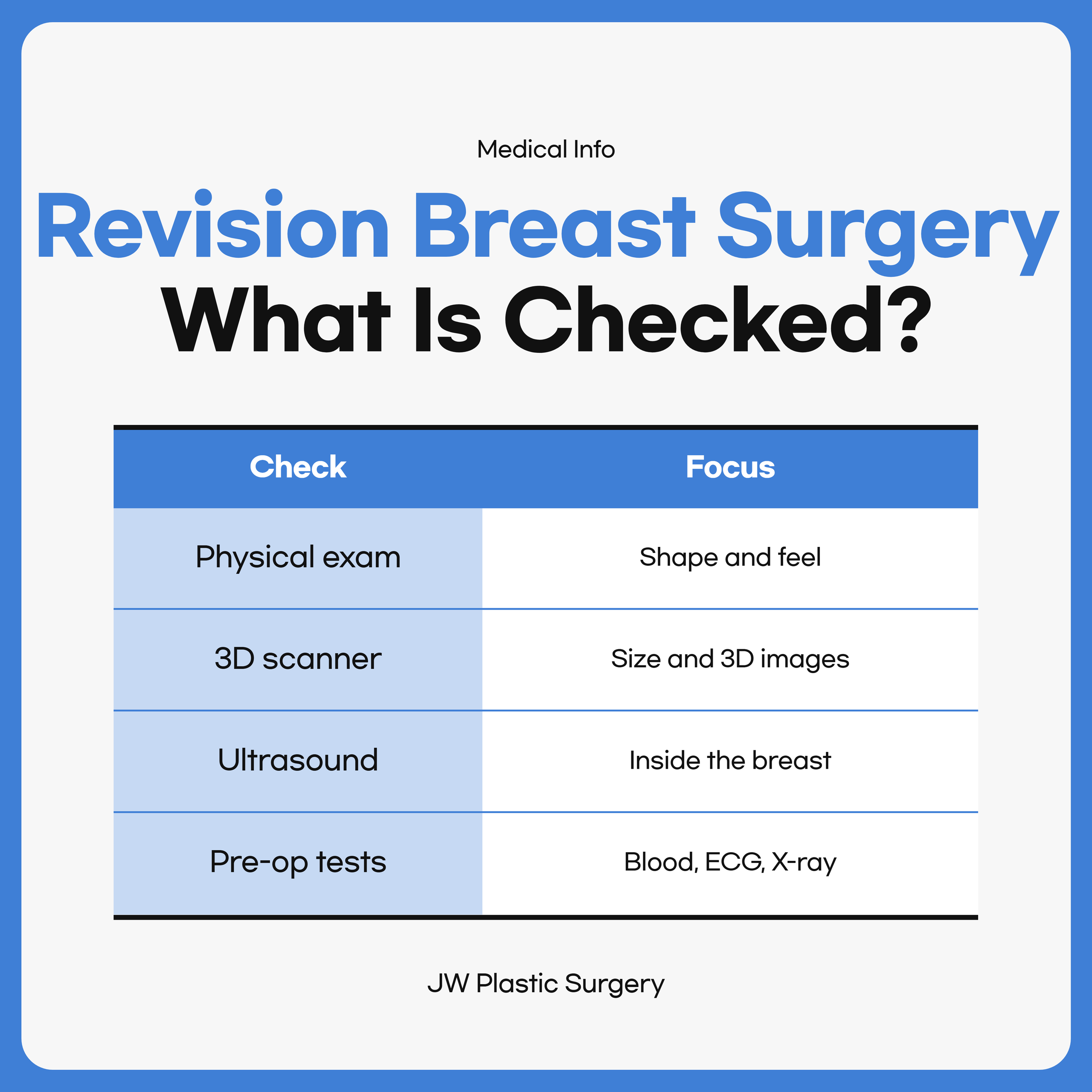
What Is Checked Before Revision Breast Surgery?
Before revision breast surgery, your surgeon can check how your breasts look and feel, record their measurements and shape with a 3D scanner, look inside with breast ultrasound when needed, and confirm your general health with pre-op tests.
| Check | Focus |
|---|---|
| Physical exam | Shape, feel and implant position |
| 3D scanner | Measurements and 3D images |
| Breast ultrasound | Inside of the breast and the implant |
| Pre-op tests | Your health before general anesthesia |
These checks matter because the need for revision can have more than one cause. Capsular contracture (hardening around the implant), an implant that has shifted or been damaged, uneven breasts and rippling (visible waves under the skin) are among the common reasons, and more than one can be present at once. Looking from several angles can help your surgeon work out which of these applies to you.
The list may differ from one patient to another, and your surgeon can explain which checks fit your situation.
What the Physical Exam Covers
The physical exam covers how your breasts look and feel, where each implant sits, and what has changed since your earlier surgery.
| Area | Detail |
|---|---|
| History | Earlier surgery and when changes began |
| Shape | Size, symmetry and sagging |
| Feel | Softness or firmness |
| Position | Implant and fold height |
| Skin | Incision scar and rippling |
The visit usually starts with your history. Your surgeon asks when your earlier surgery was done and when you first noticed a change, then compares both breasts. A difference in size, shape or breast sagging (ptosis) may come from the implants. It may also come from a difference that was there before surgery, such as chest wall asymmetry.
Firmness is judged by touch, so this part of the visit can’t be replaced by imaging. Your surgeon also looks at where each implant and the inframammary fold (the crease under the breast) sit, along with your skin, your incision scar and any rippling. Together, these details can help narrow down the cause before revision breast surgery is planned.

What the 3D Scanner Records
A 3D scanner records measurements and a three-dimensional image of your breasts, and it can show virtual implant placement on screen. Our clinic uses it to support diagnosis and to help estimate how surgery may change your shape.
Measurements help because implant size depends on more than a number. Your height, weight and chest circumference all count, and so do your skin elasticity, breast development and the amount of muscle and fat you have. That’s why the same implant can look different on two patients.
If a new implant is part of your revision breast surgery, a 3D image and a virtual placement can give you and your surgeon something concrete to discuss. The image is a simulation, and your actual result can differ depending on your body and how you heal.
Keep in mind that a 3D scanner records your outer shape. It doesn’t show the inside of your breast, and that is the role of ultrasound.
When Breast Ultrasound Is Added
Breast ultrasound is added when your surgeon needs to look at the condition inside your breast or check the implant. Our clinic performs it with a high-resolution system when needed.
Ultrasound uses sound waves rather than radiation, and the image appears in real time. In general, it can show breast tissue, the outline of an implant and any fluid around it. It may be considered if a breast has changed in size, feels different or has a lump that the exam alone doesn’t explain. Before revision breast surgery, this can help your surgeon understand what is happening under the skin.
Ultrasound has limits too. It doesn’t replace feeling how firm a breast is or talking through your goals, so it is read alongside your exam. If more imaging seems useful in your situation, your surgeon can explain why at your consultation.

Health Tests Before General Anesthesia
When revision breast surgery is done under general anesthesia, tests such as a blood test, an ECG (electrocardiogram) and a chest X-ray are needed. After you book surgery, these tests are done at our clinic, so you don’t have to visit another hospital or lab.
| Test | Focus |
|---|---|
| Blood test | Blood counts, clotting and organ function |
| ECG | Heart rhythm |
| Chest X-ray | Heart and lungs |
A blood test can look at things like blood counts, clotting and how your liver and kidneys are working. An ECG records the heart’s electrical activity, and a chest X-ray offers a view of your heart and lungs.
Please tell your surgeon about any conditions you’re being treated for, such as high blood pressure, heart disease, diabetes or thyroid disease, and about medicines that can affect bleeding, such as aspirin. If a result needs a closer look, the timing of surgery may change, and your surgeon can explain what it means for you.
How Check Results Are Used
The results are read together to help identify the cause of the change and to plan revision breast surgery around it, along with what you want.
| Source | Helps with |
|---|---|
| Exam | Likely cause |
| 3D scanner | Implant discussion |
| Ultrasound | Implant and breast condition |
| Pre-op tests | Anesthesia planning |
| Your goal | Removal or replacement |
Exam and ultrasound findings can point toward the cause. Scanner measurements and virtual placement are useful when a new implant is being considered, and pre-op tests show whether general anesthesia can go ahead as planned or needs a closer look.
Your own goal counts too. Surgical methods are combined based on the cause and on whether you’d prefer to have your implants removed or replaced, and the final method is decided with you after a full consultation. Actual outcomes differ from one patient to another, so your surgeon can explain what may be realistic for you.
📌 How a consultation works
① Your story: You explain your earlier surgery and what has changed
② Exam: Your surgeon looks at shape, feel and implant position
③ Imaging: A 3D scanner may be used, with breast ultrasound added when needed
④ Discussion: Your surgeon explains the findings and you share your goals
⑤ After booking: Pre-op tests are done at our clinic
📍 JW Plastic Surgery clinic information
- Address 3F-7F, 553 Samseong-ro, Gangnam-gu, Seoul (Samseong Jungang Station)
- Phone +82-2-541-5114
| Item | Detail |
|---|---|
| Hours | Mon-Fri 09:00-19:00, Sat 09:00-17:00, closed Sun and holidays |
| Website | https://www.jwbeauty.com |
Frequently Asked Questions (FAQ)
Q. Will I need every check before revision breast surgery?
A. It depends on your situation. Pre-op tests are needed for general anesthesia, and breast ultrasound is done when needed. Your surgeon can explain the rest.
Q. Does a 3D scanner show the inside of my breast?
A. No. It records your outer shape and measurements. Breast ultrasound is used to look inside the breast.
Q. Can a 3D image show my final result?
A. It can help with planning, but it is a simulation, and your actual result can differ from the image.
Q. Do I have to go elsewhere for pre-op tests?
A. No. After you book surgery, these tests are done at our clinic, so you don’t need a separate trip elsewhere.
Q. Do the checks decide which surgery I have?
A. They help explain the cause, and the method also depends on whether you want your implants removed or replaced. The final method is decided with you at your consultation.
Each check has a different job, and together they can make a revision plan easier to understand. Knowing what the exam, 3D scanner, ultrasound and pre-op tests look at may help you feel more prepared before revision breast surgery.
If you have questions about which checks apply to you, JW Plastic Surgery can talk them through with you at a consultation.