
📋 Summary
- ✅ Conclusion: When breasts feel hard after implants, capsular contracture is a common reason. It happens when the capsule around the implant thickens, tightens and presses on the implant.
- ✅ Causes: Collected blood, inflammation at the surgical site and a strong body response to the implant can each contribute.
- ✅ Checks: Your surgeon starts with an in-person exam, and breast ultrasound may be used when needed to find the reason.
🔍 Questions in this article
JW Plastic Surgery in Gangnam put this guide together for anyone with breast implants.
Implants that once felt soft can slowly start to feel firm, and one side may feel tighter than the other. Noticing that change can be worrying, especially if your surgery was years ago.
Capsular contracture is a common reason for this change, and an in-person exam can show whether it applies to you. This article explains why the capsule tightens, what else can make a breast firm, and how the cause is found.
– JW Plastic Surgery
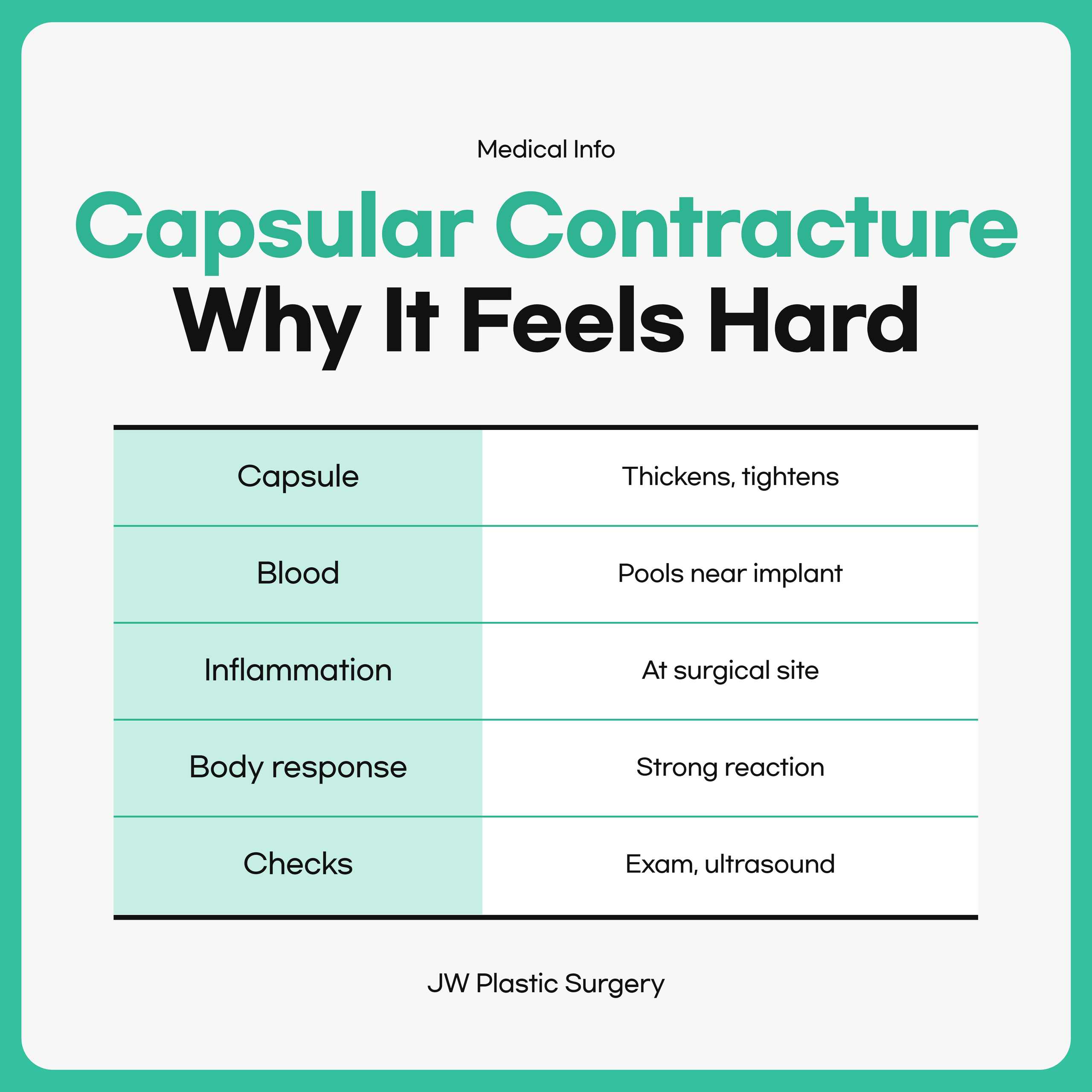
Why Capsular Contracture Makes Breasts Feel Hard
A common reason breasts feel hard after implants is capsular contracture (hardening around the implant). Your body forms a layer of scar tissue around every implant, and when that layer thickens and shrinks, it squeezes the implant and limits how freely it can move.
That pressure is what you feel as firmness. The implant inside usually hasn’t turned hard on its own. The tissue wrapped around it has become tight, much like a soft ball held in a closed fist.
In severe cases, the breast can feel firm and its shape can start to look unnatural.
How the Capsule Forms and Tightens
A capsule (a thin layer of scar tissue) forms around every breast implant, and capsular contracture starts when that layer becomes abnormally thick and contracts. The capsule itself is a normal response to an implant, and everyone who has implants develops one.
As the capsule shrinks, the space around the implant gets smaller. The implant is pressed from all sides, and in severe cases the breast can take on a rounder, more ball-like shape. This is why firmness and a shape change often show up together.
A tight capsule can also shift an implant, so it may no longer sit where it was placed. If only one breast is affected, or both are affected to different degrees, the two sides can look and feel uneven.

What Can Make the Capsule Tighten
Capsular contracture can develop when a lot of blood collects at the surgical site, when inflammation occurs there, or when your body reacts strongly to the implant. More than one of these may be involved, and sometimes no clear trigger can be found.
| Trigger | Detail |
|---|---|
| Collected blood (hematoma) | Blood pooling around the implant |
| Inflammation | Irritation at the surgical site |
| Body response | A strong reaction to the implant |
| Bacteria | Small amounts on the implant surface |
Collected blood and inflammation can both keep tissue irritated, and the capsule may respond by thickening. Your own body matters too, since some patients are more prone to this reaction than others. Research suggests that small amounts of bacteria on the implant surface may also play a part, even without signs of an obvious infection.
With these factors in mind, our doctors focus on thorough bleeding control, repeated disinfection and accurately creating the implant pocket during surgery, and medication may be prescribed afterward. These steps may lower the risk of contracture, but they can’t eliminate it.
How Firmness Is Graded
Firmness after implants can range from barely noticeable to hard and sore, and doctors often describe it with the Baker scale, a four-grade system for capsular contracture. It is based on how the breast feels and looks during an exam.
| Grade | Feel | Look |
|---|---|---|
| I | Soft | Natural |
| II | Slightly firm | Usually natural |
| III | Firm | Visibly changed |
| IV | Hard, may be sore | Clearly distorted |
At grade I, the breast feels soft and looks natural, even though a capsule is there. At grade II, you may notice slight firmness, while the shape usually looks normal. At grade III, the firmness is easier to feel, and the shape or position can start to look different.
At grade IV, the breast is hard, may feel sore or tender, and can look noticeably distorted. What the grade means for you depends on your exam, your symptoms and your goals, and your surgeon can walk you through that at your consultation.

Other Reasons a Breast Can Feel Firm
A breast can also feel firm or different because of normal swelling after surgery, implant rupture, implant malposition (an implant sitting out of place), the type of implant you have, or a lump in the breast tissue. That’s why firmness alone doesn’t confirm capsular contracture.
| Reason | Clue |
|---|---|
| Early swelling | Soon after surgery, may ease with healing |
| Implant rupture | Size or shape change, or no signs |
| Malposition | Implant sits too high or too low |
| Implant type | Anatomical implants can feel a bit firmer |
| Breast lump | A new, separate firm spot |
Swelling is expected early in recovery and can make the breasts feel tight for a while. Implant rupture can change the size, shape or feel of a breast, though a silicone implant may rupture with no obvious signs. A rupture and a tight capsule can also occur together.
With malposition, a breast can look and feel different because the implant has moved from where it should sit. Anatomical (teardrop) implants can feel slightly firmer than round implants. A new lump needs its own evaluation, whether or not it seems related to your implant. If you have sudden swelling on one side, severe pain, redness or fever, seek medical care promptly.
How the Cause of Hardness Is Found
The reason a breast feels hard can be found with an in-person exam and, when needed, breast ultrasound. Your surgeon starts by asking when you first noticed the firmness and whether it affects one side or both.
| Check | Focus |
|---|---|
| History | Timing, past surgery, symptoms |
| Physical exam | Softness, shape, implant position |
| Ultrasound | Inside of the breast and the implant |
| Other imaging | Considered if more detail would help |
During the exam, your surgeon compares both breasts by feel and by sight. Breast ultrasound can show the condition inside the breast and helps check the implant, and our clinic performs it with a high-resolution system when needed. Generally, other imaging such as MRI may be considered if questions remain.
These findings help separate capsular contracture from the other causes above. If it is confirmed, whether to treat it depends on how severe it is and how much it bothers you. Revision breast surgery is one possible path, and your surgeon can explain what may fit your situation. Results vary from patient to patient.
📌 How a consultation works
① Your concerns: You share which side feels firm and when it started
② Surgery history: You tell us what you know about your previous surgery
③ Exam: Your surgeon checks softness, shape and implant position
④ Ultrasound: The inside of the breast may be checked when needed
⑤ Explanation: Your surgeon goes over the likely reason and your options
📍 JW Plastic Surgery clinic information
- Address 3F-7F, 553 Samseong-ro, Gangnam-gu, Seoul (Samseong Jungang Station)
- Phone +82-2-541-5114
| Item | Detail |
|---|---|
| Hours | Mon-Fri 09:00-19:00, Sat 09:00-17:00, closed Sun and holidays |
| Website | https://www.jwbeauty.com |
Frequently Asked Questions (FAQ)
Q. Does everyone with implants get a capsule?
A. Yes. A capsule forms around every implant as a normal response. It becomes a concern when it grows abnormally thick and tightens.
Q. Does a hard breast always mean capsular contracture?
A. No. Swelling, implant rupture, malposition and implant type can also affect how a breast feels. An exam can help find the reason.
Q. Can capsular contracture start long after surgery?
A. It can. Timing varies from patient to patient, so new firmness is worth having checked even if your surgery was long ago.
Q. Can massage keep a breast from getting hard?
A. Whether massage is advised depends on the implant, and it can’t rule out hardening. Some smooth implants may call for massage after surgery, while those with a treated surface may not. Your surgeon can tell you what applies to yours.
Q. Can only one breast be affected?
A. Yes. It can develop on one side, or on both sides to different degrees, and the breasts may then look uneven.
Firmness that wasn’t there before has a reason behind it, and that reason isn’t always the same. Knowing whether capsular contracture or something else is causing the change can help you decide what to do next.
To book an exam at JW Plastic Surgery, please call +82-2-541-5114.