
📋 Summary
- ✅ Conclusion: If your implant has moved up or your breasts look uneven, revision breast surgery may be an option once your surgeon has confirmed the cause.
- ✅ Causes: A shift can involve capsular contracture (hardening around the implant), the implant pocket or aftercare. Unevenness can also come from differences present before surgery.
- ✅ Options: Depending on the cause, revision breast surgery may involve the tissue around the implant, the pocket, the implant itself or fat grafting.
🔍 Questions in this article
Hello from JW Plastic Surgery in Gangnam, Seoul.
Maybe your bra fits differently on one side now, or one implant seems to sit higher than it used to. Changes like these can be hard to stop thinking about.
An implant that has moved up and breasts that look uneven can each have more than one cause. Below, we go through those causes, how they are found, and the revision breast surgery options that may apply.
– JW Plastic Surgery
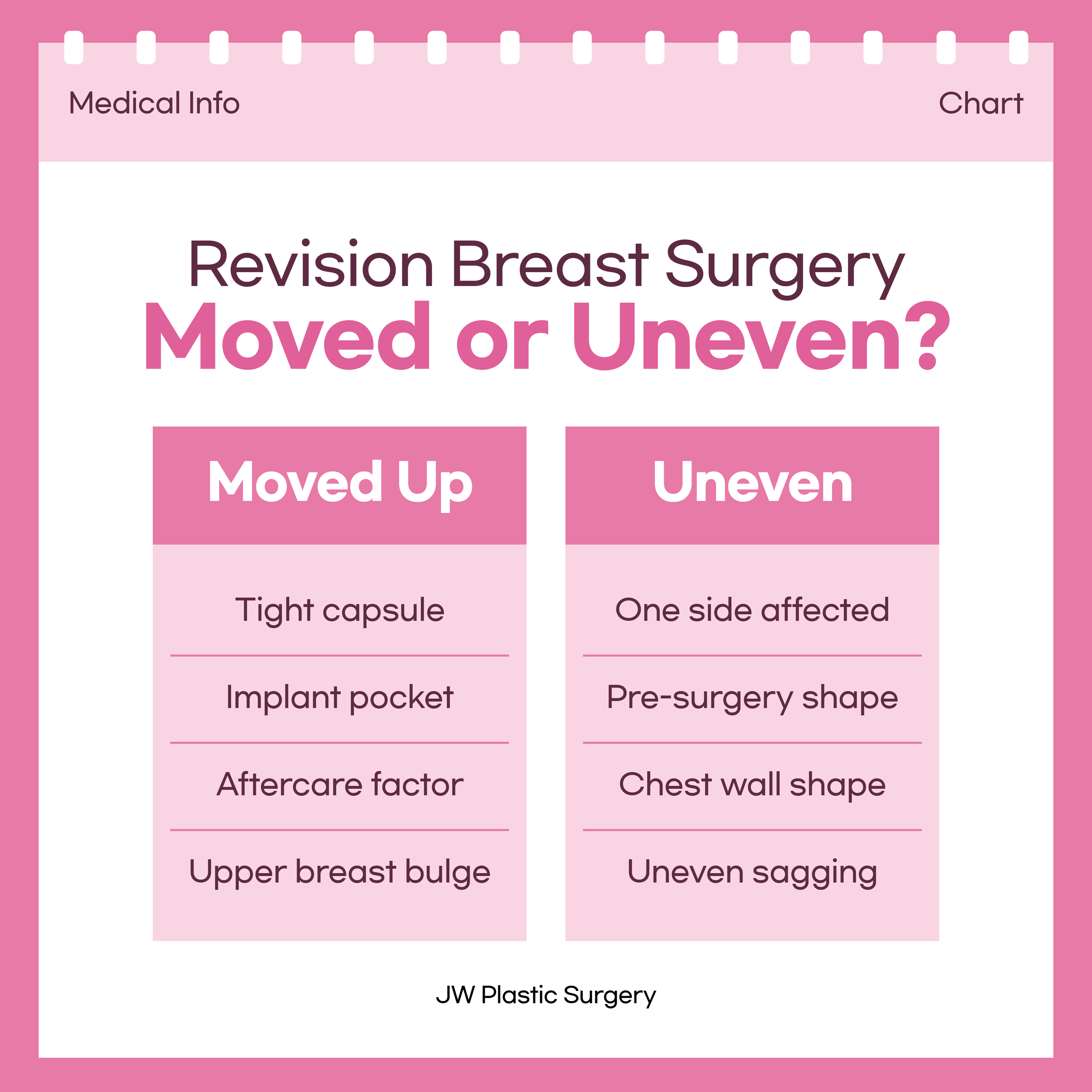
Is Revision Breast Surgery an Option?
If your implant has moved up or your breasts look uneven, revision breast surgery may be an option, and the right plan depends on what is causing the change. Revision breast surgery is done after breast augmentation, breast reduction, breast lift or reconstruction when the result isn’t what you hoped for or a complication has developed.
Implant malposition (an implant sitting out of place) and asymmetry (a visible difference between the two sides) are both common reasons to consider it. Capsular contracture is another, and it can be what moved the implant.
The change you see doesn’t tell you the cause on its own. If your implant also feels firm, or if only one side has changed, bring that up at your consultation. Your surgeon can go over whether and when revision suits you.
Why an Implant Can Move Up
An implant can move up when capsular contracture tightens the space around it, when the pocket doesn’t hold the implant in the intended spot, or when aftercare has played a part.
| Cause | Effect |
|---|---|
| Capsular contracture | A tight capsule can push the implant higher |
| Implant pocket | The space may not hold the implant in place |
| Aftercare | Recovery can affect where the implant settles |
Your body forms a capsule (a layer of scar tissue) around any breast implant. With capsular contracture, that capsule becomes too thick. As it tightens, it can squeeze the implant upward and change how the breast looks and feels.
The implant pocket is the space created to hold the implant. If that space doesn’t match the implant’s size or intended position, the implant may not stay where it was meant to sit.
Aftercare can be a factor too, so it helps to tell your surgeon how your recovery went and when you first noticed the change.

Why Breasts Can Look Uneven
Breasts can look uneven for two main reasons: a capsule or implant problem that affects one side more than the other, or differences that were already there before surgery. Each reason points to a different plan, so revision breast surgery for asymmetry starts with working out which one applies.
Capsular contracture or implant malposition may develop in only one breast, or affect both to different degrees. Either way, the two sides can end up with a different height or shape.
Before your first surgery, your breasts may have differed in size, shape or degree of breast sagging (ptosis), or your chest wall may have been asymmetric. If those differences weren’t fully corrected, they may still show.
Signs Your Implant Has Shifted
A shifted implant can show up as a bulge in the upper breast, a hollow upper breast, a double fold, breasts that touch in the middle, or breasts that sit too far apart. When this happens more on one side, a position problem can also look like unevenness.
| Shift | Signs |
|---|---|
| Too high | A bulge in the upper breast |
| Too low | A hollow upper breast |
| Too low | A double fold under the breast |
| Too close | Breasts that touch in the middle |
| Too far to the side | A wide gap and little cleavage |
When an implant sits too high, fullness gathers in the upper breast and you may see a bulge there. When it settles too low, the upper breast can look hollow, or a second crease can form under the breast. That double fold is called double-bubble deformity.
Implants that sit too close to the center can make the breasts look joined, which is called symmastia. Implants that sit too far toward the sides can widen the gap and leave little cleavage.

How Is the Cause Found?
An in-person exam can look into the cause, and a 3D scanner or breast ultrasound may be added depending on what your surgeon finds.
| Check | Detail |
|---|---|
| Physical exam | Implant position, fold, shape and feel |
| 3D scanner | Measurements, 3D images, virtual implant placement |
| Ultrasound | Inside of the breast and the implant |
During the physical exam, your surgeon looks at where each implant and fold sits and how firm each breast feels, since capsular contracture can change feel as well as shape.
A 3D scanner can take measurements and create a 3D image of your breasts. It also allows virtual implant placement on screen, which may help with planning. Actual results vary from patient to patient.
Ultrasound shows the condition inside the breast and can be used to check the implant. It is done when needed.
Revision Options by Cause
Revision options work on the capsule, the pocket or the implant, or add fat grafting, and they may be combined based on your cause and your goals.
| Option | Use |
|---|---|
| Capsulotomy (opening the capsule) | Widens a tight pocket |
| Capsulectomy (capsule removal) | Removes the capsule in severe contracture |
| Plane change (new pocket) | Places a new implant in a new layer |
| Capsulorrhaphy (narrowing the pocket with sutures) | Narrows an oversized pocket |
| Different implants | Addresses a difference between sides |
| Mastopexy (breast lift) | Addresses uneven sagging |
| Fat grafting | Addresses shape or chest wall asymmetry |
If the pocket is too tight, capsulotomy may widen the space. If severe capsular contracture has shifted the implant, capsulectomy may help address that change.
A plane change closes the existing space and creates a new pocket in a different layer, where a new breast implant is placed. If the pocket is too large, capsulorrhaphy uses sutures to narrow it, and this can be done with a full-HD endoscope.
For asymmetry, any capsular contracture or position problem is addressed along with the difference itself. A different implant on each side may also be used. Mastopexy may help when the two sides sag differently, and fat grafting may help with shape or chest wall asymmetry.
Your plan also depends on whether you want your implant removed or replaced. Your surgeon can explain how revision breast surgery might apply to you, along with recovery details, at your consultation.
📌 How a consultation works
① Listening: You tell us what has changed and what you want
② Exam: Your surgeon checks implant position, shape and feel
③ Imaging: A 3D scanner or ultrasound may be used as needed
④ Explanation: Your surgeon explains the likely cause and your options
⑤ Health check: Tests before surgery may include a blood test, ECG and chest X-ray
📍 JW Plastic Surgery clinic information
- Address 3F-7F, 553 Samseong-ro, Gangnam-gu, Seoul (Samseong Jungang Station)
- Phone +82-2-541-5114
| Item | Detail |
|---|---|
| Hours | Mon-Fri 09:00-19:00, Sat 09:00-17:00, closed Sun and holidays |
| Website | https://www.jwbeauty.com |
Frequently Asked Questions (FAQ)
Q. Can an implant that moved up be corrected without replacing it?
A. That depends on the cause. Your surgeon can explain whether your implant can stay. Capsulotomy and capsulorrhaphy work on the capsule or the pocket, while a plane change involves a new breast implant.
Q. Can just one breast be affected?
A. Yes. Capsular contracture or implant malposition can develop on one side only, or on both sides to different degrees.
Q. Could my aftercare have caused the shift?
A. It can be one factor, along with capsular contracture and the implant pocket.
Q. Can fat grafting help if my breasts look uneven?
A. It may help with differences in breast shape or chest wall asymmetry, depending on what is causing them.
Q. How soon should I have revision breast surgery after I notice a change?
A. Timing depends on the cause and your current condition. Your surgeon can talk through when revision may suit you at your consultation.
A breast that has changed after surgery can feel unsettling, and it’s reasonable to want a clear explanation. Knowing whether the cause lies with the capsule, the pocket or a difference from before surgery can help you weigh your revision breast surgery options.
To book a consultation with JW Plastic Surgery, call +82-2-541-5114.