
📋 Summary
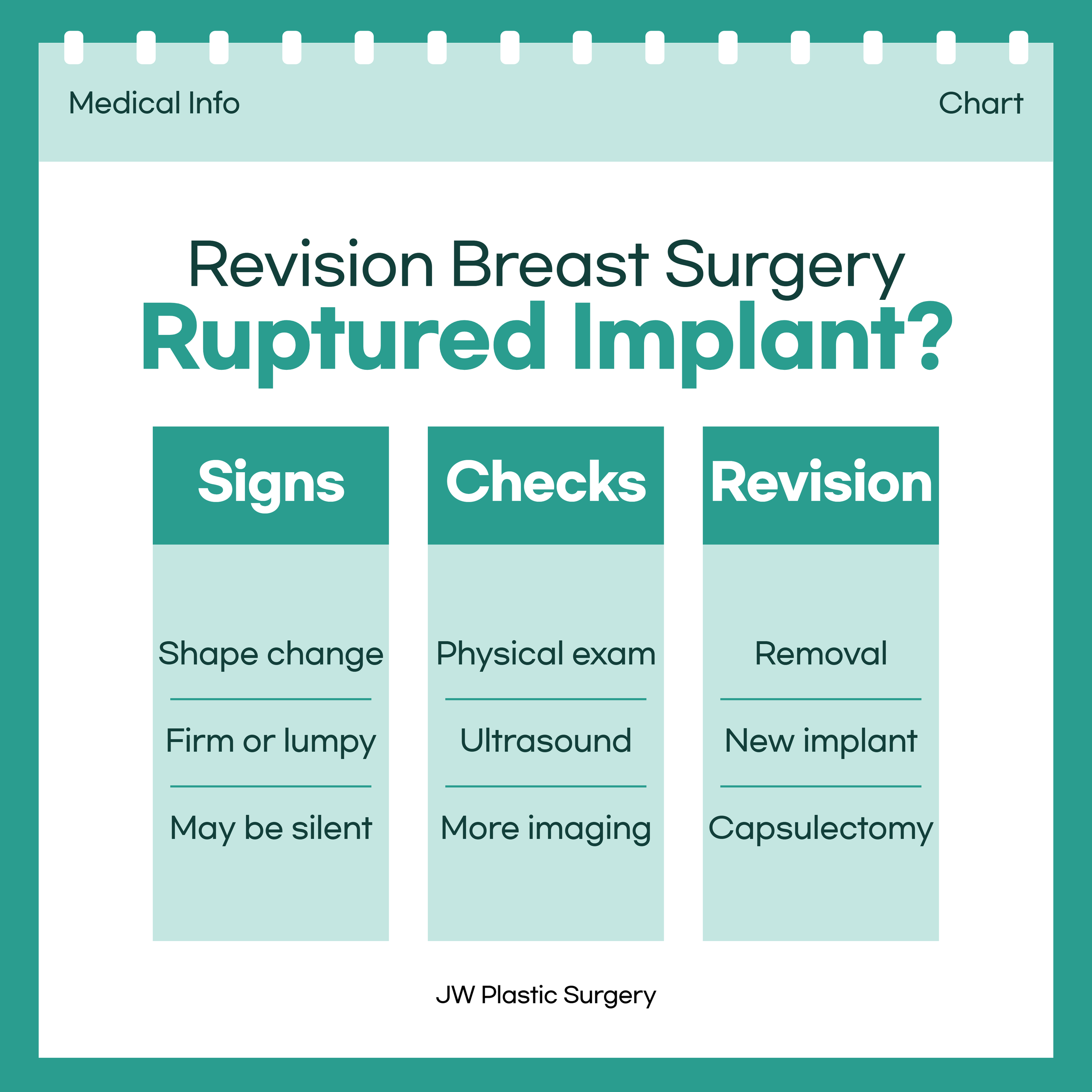
- ✅ Conclusion: If you suspect a ruptured implant, have it examined first. If implant rupture is confirmed, revision breast surgery may be an option to remove the old implant and place a new one.
- ✅ Signs: A rupture can change the size, shape or feel of a breast, and a silicone implant can also rupture with no obvious signs.
- ✅ Checks: Your surgeon starts with an in-person exam, and breast ultrasound may be used when needed to check the implant.
🔍 Questions in this article
This is JW Plastic Surgery in Gangnam, and we’re glad you’re here.
Perhaps one breast has started to look different, or a new firmness or soreness has you wondering about your implant. If it has been in place for years, that worry can be hard to set aside.
A suspected rupture can be checked in person, and the next step depends on what the exam finds. This article covers why implants can rupture, which signs to watch for, how a rupture is confirmed, and what revision breast surgery can involve.
– JW Plastic Surgery
Is Revision Breast Surgery the Next Step?
If you suspect a ruptured implant, the first step is an exam, and revision breast surgery may be an option if implant rupture is confirmed. Revision breast surgery is done after breast augmentation and other breast procedures when a complication has developed or the result isn’t what you hoped for. A damaged or ruptured implant is one of the reasons to consider it.
When a rupture is found, the plan centers on taking out the old breast implant. What comes next depends on your exam, the condition of the capsule (the layer of scar tissue around the implant), and whether you want a new implant or removal alone.
You don’t need to be sure before you come in. Your surgeon can go over what the findings mean for you.
Common Causes of Implant Rupture
An implant can rupture when its outer shell weakens over time, when the chest takes a strong impact, or when the implant is stressed during placement. Sometimes no single cause can be identified. Your history still helps your surgeon understand what happened before discussing revision breast surgery.
| Cause | Effect |
|---|---|
| Shell wear | The outer shell can weaken with time |
| Impact | Strong force can damage the implant |
| Placement | Stress during insertion can cause damage |
| Tight capsule | Ongoing pressure may stress the shell |
Breast implants don’t have a fixed expiration date, so age alone doesn’t mean yours has ruptured. Older-generation implants were more likely to rupture as they aged, and newer ones have become more durable. An implant of any age can still be damaged, for example in a hard fall.
During placement, an implant passes through a small incision, and it can be damaged if it is stressed along the way. Capsular contracture (hardening around the implant) may also play a part, since a thick, tight capsule can keep pressure on the shell.

Signs of a Ruptured Implant
A ruptured implant can show up as a change in breast size or shape, a new lump or firmness, or pain and swelling, though a silicone implant may rupture with no obvious signs at all.
| Change | Signs |
|---|---|
| Size or shape | One breast looks smaller or different |
| Feel | New firmness, lumps or unevenness |
| Comfort | Pain, tenderness, tingling or swelling |
| No signs | Silent rupture, found on imaging |
What you notice can depend on the implant type. A saline implant tends to lose volume quickly when it ruptures, so the breast can look noticeably smaller. Silicone gel is thicker and may stay inside the capsule, so the breast can look about the same. This is called silent rupture.
None of these signs confirms a rupture on its own, but each is a good reason to get checked.
How a Rupture Is Confirmed
A suspected rupture is checked with an in-person exam, and imaging such as breast ultrasound can help confirm it.
| Check | Detail |
|---|---|
| Physical exam | Size, shape, firmness and lumps |
| Ultrasound | Inside of the breast and the implant |
| MRI | Another imaging test, if needed |
During a physical exam, your surgeon can compare both breasts, feel for firmness or lumps, and ask when you first noticed the change.
Breast ultrasound shows the condition inside the breast and can be used to check the implant. Our clinic uses a high-resolution ultrasound system and performs this test when needed.
Generally, MRI is another imaging test for a silicone implant rupture, and your surgeon can tell you where it can be done. If further imaging would help in your situation, your surgeon can explain your options before you decide on revision breast surgery.
Other Problems That Can Feel Similar
Firmness, a shape change or unevenness can also come from capsular contracture, implant malposition (an implant sitting out of place) or rippling (visible wrinkling through thin tissue). Each one can lead to a different revision breast surgery plan, which is why the exam matters when you suspect a rupture.
With capsular contracture, the capsule around the implant becomes too thick, and the shape and feel of the breast can start to seem unnatural. In severe cases, the breast can feel hard. With implant malposition, the implant may sit too high, too low, too close to the center or too far to the side.
Rippling is related to thin tissue over the implant, and an oversized implant can add to it. A rupture and capsular contracture can also happen together, so a firm breast may still need imaging to tell what is going on.
What Revision Involves After a Rupture
After a confirmed rupture, revision breast surgery can involve removing the ruptured implant completely and placing a new one, with capsulectomy (capsule removal) added if the capsule is in poor condition.
| Step | Role |
|---|---|
| Implant removal | Takes out the ruptured implant |
| New implant | Replaces it, if that is your goal |
| Capsulectomy | Removes a capsule in poor condition |
| Incision | The existing incision may be reopened |
Your own goal shapes the plan, because revision can mean replacing the implant or removing it. If you choose a new breast implant, the implant brand is chosen with you after a full consultation.
Revision may be possible through the incision from your first surgery, whether that was an axillary (armpit) incision, a periareolar incision or an inframammary fold incision. Reopening the existing incision can help avoid adding a new incision elsewhere. For the armpit route, our doctors can use a full-HD endoscope to see inside the breast.
Which steps apply to you depends on your findings and your condition, and results vary from patient to patient. Your surgeon can explain recovery details at your consultation.
📌 How a consultation works
① Your concerns: You describe what changed and when you noticed it
② Exam: Your surgeon checks breast size, shape and feel
③ Imaging: Breast ultrasound may be used as needed
④ Plan: Your surgeon goes over the findings and whether to replace or remove the implant
⑤ Pre-op tests: Tests before surgery may include a blood test, ECG and chest X-ray
📍 JW Plastic Surgery clinic information
- Address 3F-7F, 553 Samseong-ro, Gangnam-gu, Seoul (Samseong Jungang Station)
- Phone +82-2-541-5114
| Item | Detail |
|---|---|
| Hours | Mon-Fri 09:00-19:00, Sat 09:00-17:00, closed Sun and holidays |
| Website | https://www.jwbeauty.com |
Frequently Asked Questions (FAQ)
Q. Can an implant rupture without any symptoms?
A. Yes. A silicone implant can rupture with no obvious change, which is called silent rupture. It may only be found on imaging.
Q. Can ultrasound check for a rupture?
A. Yes, it can be used to look at the implant and the condition inside the breast. It is done when needed.
Q. Do I need to replace my implants on a set schedule?
A. Implants don’t have a fixed lifespan, so routine replacement generally isn’t needed unless there is a problem such as rupture. Still, follow-up checks matter, since a silicone implant can rupture with no obvious signs.
Q. Will the capsule need to be removed too?
A. It depends on the capsule. If it is in poor condition, capsulectomy may be done along with revision breast surgery to remove the implant.
Q. Should I wait to see if the change goes away?
A. Having it checked can give you a clearer answer than waiting. Any timing for surgery depends on your findings. If you have severe pain, fever, redness or rapid swelling, seek medical care promptly.
A suspected rupture is worth checking even when nothing hurts. Finding out whether your implant is intact, or whether something else is behind the change, can give you a clearer basis for deciding whether revision breast surgery fits your goals.
You can schedule an exam at JW Plastic Surgery by calling +82-2-541-5114.