
📋 Summary
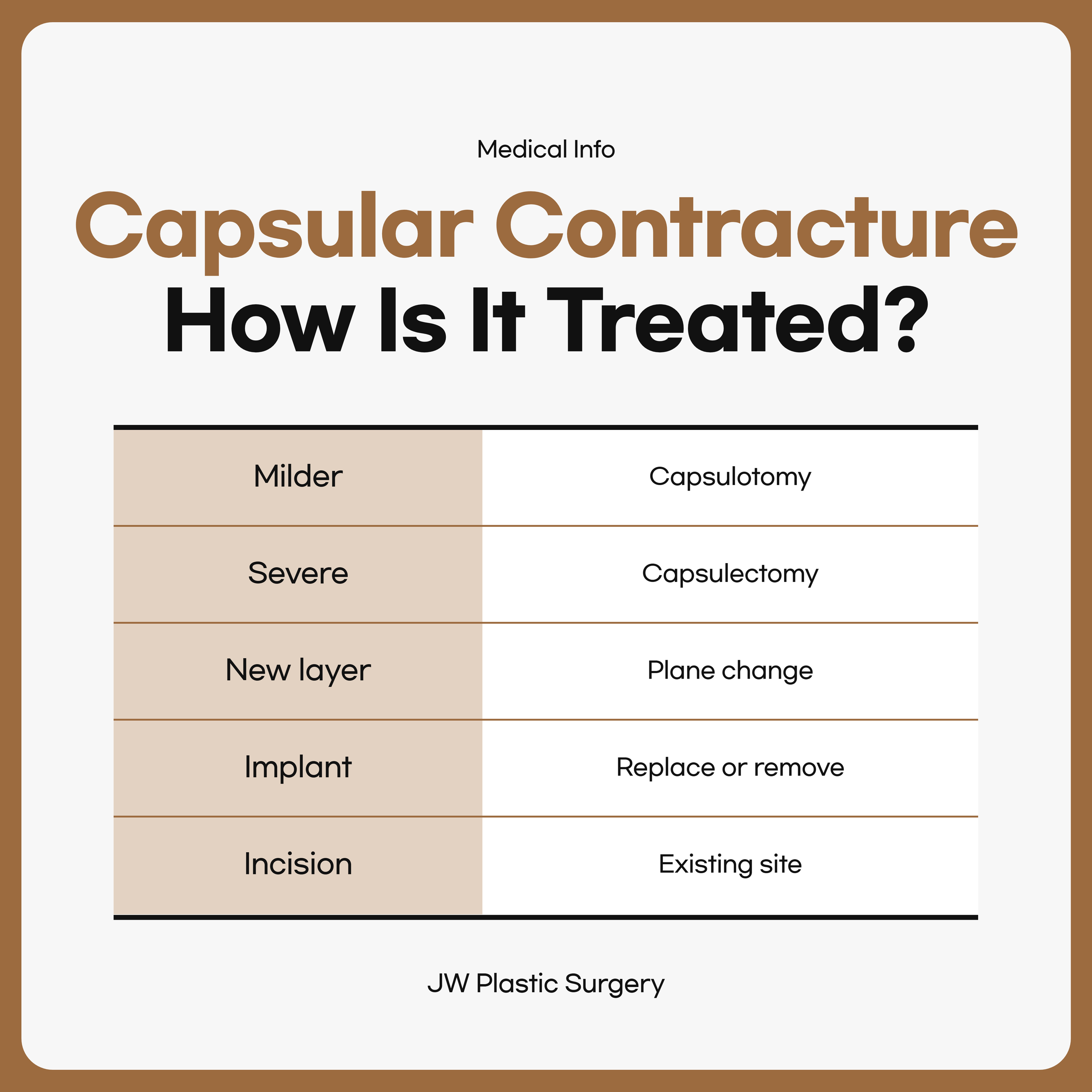
- ✅ Conclusion: Capsular contracture that needs treatment is generally treated with revision breast surgery, and the method depends on severity: capsulotomy for milder contracture, capsulectomy for severe contracture, or an implant plane change.
- ✅ Methods: Capsulotomy opens the capsule (scar tissue around the implant), capsulectomy removes it, and a plane change places a new implant in a new layer.
- ✅ Choices: Your plan may also depend on implant position, your wish to replace or remove the implant, and the site of your first incision.
🔍 Questions in this article
You’re reading a guide from JW Plastic Surgery in Gangnam, Seoul.
Once a firm breast has been diagnosed as capsular contracture, the question usually changes from what it is to what can be done. It’s natural to want a straight answer before you book a visit, especially if you’ve already been through surgery once.
Treatment depends on how severe the hardening is, and you’ll have options to discuss with your surgeon. Below, we go through each method, the choice between a new implant and removal, and what shapes the final plan.
– JW Plastic Surgery
How Is Capsular Contracture Treated?
Capsular contracture (hardening around the implant) that needs treatment is generally treated with revision breast surgery, and the method depends mainly on how severe it is. Capsulotomy may be used for milder contracture and capsulectomy for severe contracture. An implant plane change is a further option, in which a new implant goes into a new layer.
| Method | Used for | Action |
|---|---|---|
| Capsulotomy | Milder contracture | Opens the capsule |
| Capsulectomy | Severe contracture | Removes the capsule |
| Plane change | Creating a new pocket in a new layer | Closes the old pocket, places a new implant |
Every breast implant develops a capsule, a thin layer of scar tissue around it. Treatment is aimed at a capsule that has grown too thick and begun to tighten, which can make the breast firm and its shape unnatural.
These methods can also be combined. Your surgeon puts them together according to the cause and the improvement you want, so two patients with capsular contracture may not have the same operation.
Capsulotomy for Mild Contracture
Capsulotomy (opening the capsule) may be used for milder capsular contracture. The capsule is opened so the pocket, the space that holds the implant, can be widened. Generally, the capsule stays in the body with this method instead of being taken out, which is the main difference from capsulectomy.
If the implant has been held out of place in a tight space, capsulotomy can give it more room, so your surgeon may consider it for position problems as well.
Whether your contracture counts as mild needs a hands-on exam, and your surgeon can explain whether capsulotomy alone may be enough.

Capsulectomy for Severe Contracture
Capsulectomy (capsule removal) may be used for severe capsular contracture, and the thickened capsule is taken out. Contracture is considered severe when the capsule has tightened enough to round the breast into a ball-like shape and make it feel hard.
This method can also help with position. A tight capsule can shift an implant from where it was placed, and removing the capsule may help correct that change.
Capsule removal calls for a clear view inside the breast, so our doctors can use a full-HD endoscope (a small camera) during revision. The capsule can come out with the old implant, which leads to the next decision: what goes back in, if anything.
Changing the Implant Plane
An implant plane change is another way to treat contracture: the old pocket is closed, a new pocket is made in a different layer, and a new breast implant is placed there.
| Step | Detail |
|---|---|
| Close | The old pocket is closed |
| Create | A new pocket is made in a new layer |
| Place | A new breast implant goes in |
The word plane refers to the tissue layer that holds the implant. A breast implant sits under the glandular tissue or under the pectoralis major (the large chest muscle), so a plane change means building the pocket in a different layer from the current one.
Since the new pocket is made from scratch, your surgeon can place it where the implant should sit, which may also help if your implant has moved. Which layer may suit you depends on your exam, and your surgeon can go over this at your consultation.

New Implant or Implant Removal?
Treating capsular contracture can involve either a new breast implant or taking the implant out, and the choice follows the cause and what you hope to change.
| Choice | Meaning |
|---|---|
| New implant | A new implant replaces the old one |
| Removal | The implant comes out with no replacement |
| Fat grafting | May be added for shape or an uneven chest |
If you lean toward a new implant, our clinic carries a range of implants, and you can try sizers inside a bra to get a feel for the size before deciding.
If you lean toward removal, expect that breast size and shape may change, and ask how that may look on your frame. Fat grafting (moving your own fat) can be added to adjust shape or an uneven chest wall.
What Shapes Your Treatment Plan
Your treatment plan is shaped by the severity of the capsular contracture, where the implant sits, what you want to change and where your first incision is.
| Factor | Effect |
|---|---|
| Severity | Points to capsulotomy or capsulectomy |
| Position | May call for capsule work or a plane change |
| Two sides | Each breast may need a different approach |
| Incision | The existing site may be reopened |
Severity and position start with an in-person exam of firmness, shape and implant position. Doctors often describe severity on the Baker scale, which runs from grade I (soft) to grade IV (hard and painful with visible change). Breast ultrasound can also be done when needed to see the inside of the breast and check the implant.
The two sides may not match. Contracture can affect one breast alone, or both to different degrees, and that can leave them uneven. The plan may then differ by side, and a different implant for each breast is one option.
Revision has generally been done through a periareolar incision or an inframammary fold incision. With endoscopic techniques, our doctors can also work through an axillary (armpit) incision. If your first surgery used the areola or the fold, that same site may be used again. Results vary from patient to patient, so your surgeon can tell you which approach fits your situation.
📌 How a consultation works
① History: You describe when the firmness began and how your first surgery was done
② Exam: Your surgeon feels both breasts and looks at shape and implant position
③ Imaging: Breast ultrasound is added if it is needed
④ Options: You talk through which method may fit and whether to replace or remove the implant
⑤ Pre-op tests: If you choose surgery, testing may include a blood test, ECG and chest X-ray on site
📍 JW Plastic Surgery clinic information
- Address 3F-7F, 553 Samseong-ro, Gangnam-gu, Seoul (Samseong Jungang Station)
- Phone +82-2-541-5114
| Item | Detail |
|---|---|
| Hours | Mon-Fri 09:00-19:00, Sat 09:00-17:00, closed Sun and holidays |
| Website | https://www.jwbeauty.com |
Frequently Asked Questions (FAQ)
Q. Can medication or massage treat capsular contracture?
A. At our clinic, medication and massage are preventive steps after surgery. For contracture that has already developed, the methods described here are surgical, and your surgeon can tell you whether surgery is needed for you.
Q. Can only one breast be treated?
A. It may be possible if contracture affects one side. Your surgeon can also look at how the two breasts balance before you decide.
Q. Will treatment leave another scar?
A. Any incision leaves a scar. Reopening your existing incision may help you avoid adding one at a new site.
Q. Can capsular contracture come back after treatment?
A. It can. A new capsule forms around any implant, and how it behaves varies from patient to patient. Steps such as controlling bleeding and rinsing the pocket with antibiotics aim to lower the risk, and your surgeon can discuss your own risk.
Q. What follow-up comes after surgery?
A. Your surgeon checks your progress after breast surgery, with early check-ups followed by visits at three-month intervals through the first year. Check-ups remain available after that if a concern comes up.
Treatment choices are easier to weigh once you know what each one does. Capsulotomy, capsulectomy and a plane change each address a different problem, so learning how severe your capsular contracture is can be a useful next step.
To arrange a consultation, phone JW Plastic Surgery at +82-2-541-5114.