
📋 Summary
- ✅ Conclusion: If your eyelids still feel heavy once swelling has settled, revision eye surgery may help after your surgeon has identified the cause.
- ✅ Causes: Heaviness can come from ptosis (droopy eyelid) that remains or has returned, or from the volume and skin of the eyelid.
- ✅ Timing: An incised area generally needs at least 6 months before revision, though timing can differ after ptosis correction.
🔍 Questions in this article
Welcome to JW Plastic Surgery in Gangnam.
Maybe you had eye surgery hoping your eyes would feel lighter. Now your eyelids still feel heavy, you catch yourself raising your eyebrows to see clearly, or friends ask if you’re tired.
That heaviness can have more than one cause, and revision eye surgery is planned around the one that applies to you. Below, we go through the causes, the exam, your options and timing.
– JW Plastic Surgery
Can Revision Eye Surgery Help Heavy Eyelids?
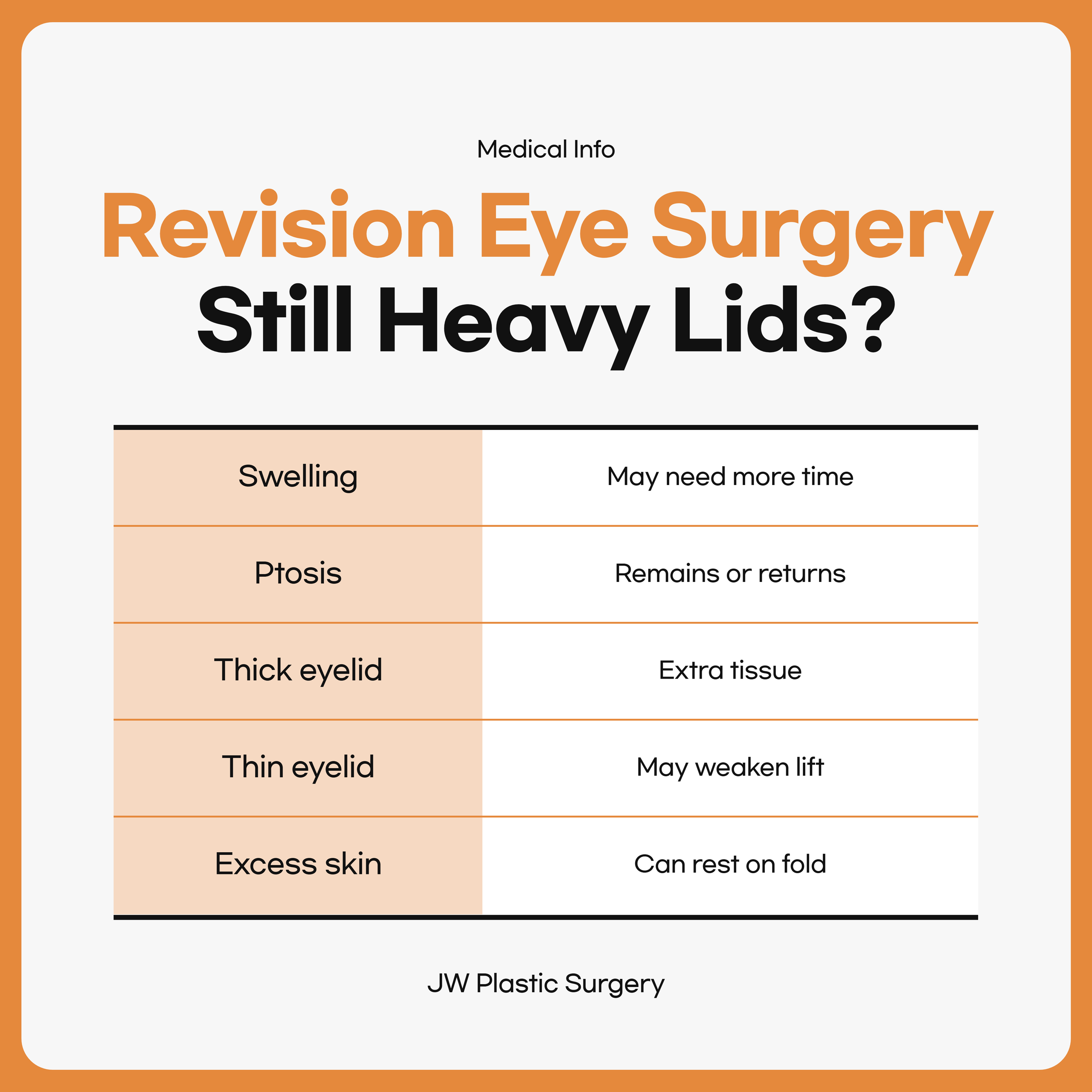
Revision eye surgery may help heavy eyelids when the feeling continues after swelling has settled and your surgeon can identify what’s behind it. Eye-opening strength plays a large part in revision eye surgery, so ptosis correction often comes up in this conversation.
Heaviness is a feeling, so the first step is matching it to something an exam can show. Your upper eyelid may sit too low, or it may be carrying extra volume or skin.
Most revision involves several factors at once, so more than one can apply to you. Your surgeon can tell you at your consultation whether revision looks suitable.
Still Swelling or a Lasting Problem?
Heaviness early on can simply be swelling, while heaviness that stays after the swelling fades may point to a lasting cause. A swollen eyelid is thicker, so it can be harder to lift until the tissue calms down. Swelling tends to last longer after an incisional procedure.
A few changes can suggest something beyond swelling. The heavy feeling may stay the same as the puffiness goes down, or your eye may look smaller or sleepier than you expected. You may also notice your forehead working harder, since people with ptosis often raise their brows to help lift the eyelid.
No single sign confirms a cause, but an exam can help show whether the tissue needs more time or whether revision eye surgery is worth discussing.

Why Ptosis Can Remain After Surgery
Ptosis can remain after surgery because it wasn’t corrected at the time, was undercorrected, or came back later. With your eyes open normally, the upper eyelid usually covers about 1 to 2 mm of the upper iris (the colored part of the eye). When it covers more, the eye can look sleepy and the eyelid can feel heavy.
| Cause | Detail |
|---|---|
| Uncorrected ptosis | The droop stays after fold surgery |
| Undercorrection | The eyelid was raised, but not enough |
| Recurrence | The droop returns over time |
| High fold fixation | A deep fold can come with ptosis |
| Fat grafting | Ptosis can follow grafting around the eyes |
When an eyelid sags and looks sleepy, double eyelid surgery alone may not be enough, and ptosis correction may need to be added. If the droop wasn’t addressed, the heaviness can simply carry on.
Undercorrection means the eyelid came up, but not far enough. Recurrence means it was corrected and dropped again with time. A fold fixed high can stay visible even with your eyes closed, and ptosis usually comes with it. Ptosis can also develop after fat grafting around the eyes, so your earlier procedures matter.
How Volume and Skin Add Heaviness
Volume and skin can add heaviness because the muscle that opens your eye has to lift whatever sits in the eyelid. A thick eyelid, a thin eyelid and sagging skin can each play a part.
| Eyelid | Effect |
|---|---|
| Thick | Extra tissue covers more of the fold |
| Thin | May weaken the lift |
| Sagging | The fold can sit lower over time |
| Excess skin | Can rest over the fold or lashes |
A thick eyelid carries more tissue above the fold. The fold can look very thin or almost hidden, and the eyelid can feel weighed down.
A thin eyelid sounds like the opposite problem, yet it can feel heavy too. When aging reduces eyelid volume, a thin eyelid can make the levator muscle (the muscle that lifts the upper eyelid) work less efficiently, and ptosis can come along with it.
Eyelids can also sag long after surgery, and the fold can look lower as a result. Extra upper eyelid skin, called dermatochalasis, can add to the heavy feeling and may rest over the fold or lashes.
How Your Surgeon Finds the Cause
Your surgeon finds the cause by looking at how your eyelids sit and lift, then at the tissue and the fold. Since problems can overlap, these are reviewed from several angles.
| Check | Detail |
|---|---|
| Eyelid position | How much iris each eyelid covers |
| Opening strength | How far each eyelid lifts |
| Brow use | Whether your forehead is helping |
| Tissue | Skin thickness and amount of fat |
| Fold | Height, depth, adhesion and scarring |
Eyelid position is usually checked with your forehead relaxed, since raised brows can hide a droop. Levator function is generally assessed by how far the eyelid travels from looking down to looking up. Both sides are compared, because everyone has some natural asymmetry in opening strength.
Skin thickness and the amount of fat help show how much the eyelid is carrying. Adhesion (tissue bonding where the fold forms) and scarring from your earlier surgery can affect which methods are possible.
Revision Options and Timing
Options for revision eye surgery depend on the cause and may include ptosis correction, releasing and remaking the fold, or adjusting eyelid volume.
| Cause | Option |
|---|---|
| Remaining ptosis | Ptosis correction, fold remade |
| High, deep fold | Eyelid layer repositioned, depth adjusted |
| Thick eyelid | Fat or muscle removed, fold made |
| Thin eyelid | Fold remade, fat grafting if needed |
| Excess skin | Discussed at your consultation |
Correcting remaining ptosis can change the height or shape of the fold, so the existing fold may be released and remade. Ptosis correction can be incisional or non-incisional, and the exam can help show which may suit you. For a deep fold fixed high, the front layer of the eyelid may be repositioned to bring the fold to a more natural depth.
A thick eyelid may need extra fat or muscle removed before the fold is made. A thin eyelid may need the fold remade, with fat grafting if there’s too little tissue. Your surgeon can explain options for excess skin at your consultation.
An incised area is generally given at least 6 months, and about 3 months is advised when swelling remains. After ptosis correction, a problem with eye height or shape can sometimes be revised early, within 1 to 2 weeks. Past that window, revision generally follows at 3 to 6 months, when most of the eye tissue has stabilized.
📌 How a consultation works
① History: Your earlier eye surgery and when the heaviness began
② Exam: Eyelid position and opening strength
③ Tissue check: Skin, fat, fold and scarring
④ Discussion: Likely cause, options and timing
⑤ Preparation: Any medications and conditions under treatment
📍 JW Plastic Surgery clinic information
- Address 3F-7F, 553 Samseong-ro, Gangnam-gu, Seoul (Samseong Jungang Station)
- Phone +82-2-541-5114
| Item | Detail |
|---|---|
| Hours | Mon-Fri 09:00-19:00, Sat 09:00-17:00, closed Sun and holidays |
| Website | https://www.jwbeauty.com |
Frequently Asked Questions (FAQ)
Q. Can a heavy eyelid be a sign of ptosis?
A. It can. Ptosis is one possible cause, along with eyelid volume and skin, and an exam can help tell them apart.
Q. How long does eyelid swelling last after surgery?
A. It varies from person to person, and it tends to last longer after an incisional procedure.
Q. Why do I raise my eyebrows to open my eyes?
A. People with a droopy eyelid often use the forehead muscle to help lift it. The exam can check for this.
Q. Does correcting ptosis affect my double eyelid fold?
A. It can. The height or shape of the fold can change, so the existing fold may be released and remade.
Q. Will revision eye surgery make my eyelids feel light again?
A. That can’t be promised. How your eyelids feel afterward can depend on the cause and your tissue, and results vary from patient to patient.
A heavy feeling that outlasts your recovery is a fair thing to ask about. Knowing whether it comes from swelling, remaining ptosis or eyelid volume and skin can help you decide whether revision eye surgery is right for you.
You’re welcome to call JW Plastic Surgery at +82-2-541-5114 with questions about your eyelids.