
📋 Summary
- ✅ Conclusion: If your nose looks short or pulled up after rhinoplasty, tightening scar tissue may be the reason, and revision rhinoplasty may be an option to lengthen it.
- ✅ Causes: Repeated surgery, inflammation and an implant that doesn’t suit your skin can all contribute to a contracted nose.
- ✅ Options: After an exam and a 3D CT, your surgeon can discuss lengthening methods using cartilage from your septum, ear or rib.
🔍 Questions in this article
Greetings from the team at JW Plastic Surgery in Gangnam.
After rhinoplasty, some patients notice that the nose seems shorter than it was, that the tip tilts upward, or that the nostrils show more from the front. If that sounds familiar, you may be wondering whether it will settle or whether something has changed under the skin.
A short or pulled-up nose can be examined in person, and the plan depends on why it happened. This article covers the causes, the signs, the checks before revision rhinoplasty, and how lengthening and recovery can work.
– JW Plastic Surgery
Can Revision Rhinoplasty Lengthen the Nose?
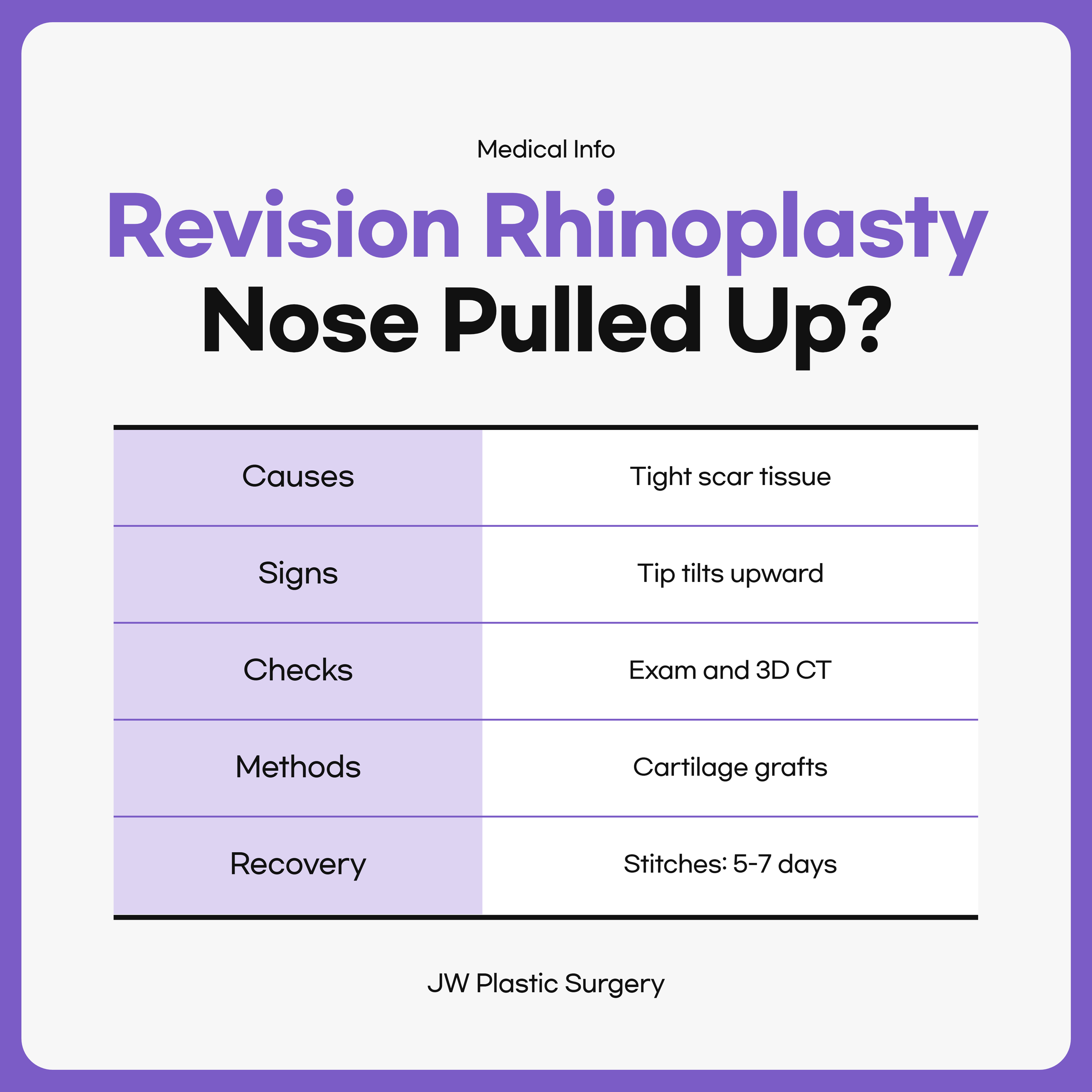
Yes, revision rhinoplasty may lengthen a nose that looks short or pulled up after earlier surgery, and it may also help bring an upturned tip down. Contracture that has lifted and shortened the nose is one of the reasons to consider it. A short nose generally lacks tissue, so the surgery usually adds length with grafts instead of only reshaping what is already there.
How much length can be added depends on your skin, your scar tissue and the cartilage available.
Results vary from patient to patient. At your exam, your surgeon can explain whether revision rhinoplasty fits your situation and how much change is realistic.
Why a Nose Shortens After Surgery
A nose can shorten after surgery when scar tissue around an implant or graft tightens and pulls the nasal tip upward. This is called a contracted nose (nasal contracture). Three factors are commonly linked to it.
| Cause | Effect |
|---|---|
| Repeated surgery | Scar tissue can build up over time |
| Inflammation | Healing tissue can stiffen and tighten |
| Implant fit | A poor match may strain thin skin |
Every operation leaves some scar tissue, so repeated surgery can leave less soft, flexible tissue. Inflammation after surgery can add to this, because inflamed tissue tends to scar and shrink as it heals.
An implant that doesn’t suit your skin can also play a part. The skin over it may become thin or red, and inflammation is also possible.
Not every short nose comes from contracture. Some noses are naturally short, and your surgical history helps your surgeon tell the difference.

Signs of a Short or Upturned Nose
A short nose or upturned nose usually shows up as a tip that tilts upward, nostrils that are easy to see from the front, and a nose that looks too short for the rest of your face. With a contracted nose, the skin may also feel tight, and the tip may feel stiff or hard to move.
The nasolabial angle (the angle between the nose and upper lip) can describe this. As a rough guide, at 110 degrees or more the nostrils can show too much from the front, though balance depends on your own features.
The skin over the nasal tip or bridge may look thin or red, or an implant may show through the skin. Mention these even if length is your main concern, because they can affect your revision rhinoplasty options.
What Is Checked Before Revision
Before revision rhinoplasty, our doctors check the length of your nose, your skin thickness, how much of the nostrils show and the nasolabial angle, and a 3D CT can add detail about what lies under the skin.
| Check | Detail |
|---|---|
| Physical exam | Skin, length, nostrils and angle |
| 3D CT | Nasal bones, soft tissue and septum |
| Morpheus 3D | Facial imaging to help plan surgery |
A 3D CT shows the nasal bones along with the shape, condition and size of the soft tissue around the nose. It can also show the size and condition of the cartilage in your nasal septum (the wall between the nostrils). That matters because septal cartilage may be used as graft material.
Our clinic also uses Morpheus 3D, a 3D facial imaging system, to analyze the face and help predict how surgery may change it. A prediction is a planning tool, and your actual result can differ.
How the Nose Can Be Lengthened
A nose can be lengthened with a septal extension graft, a derotation graft or tip cartilage repositioning, and the choice depends on how short the nose is and how much cartilage you have.
| Method | Detail |
|---|---|
| Septal extension graft | Extends the lower end of the septum |
| Derotation graft | Extends tip cartilage with ear cartilage |
| Suture repositioning | Moves tip cartilage without a graft |
| Hybrid graft | Adds other cartilage to a small septum |
A septal extension graft can use septal cartilage, rib cartilage or donor rib cartilage (from a tissue donor). A derotation graft uses ear cartilage. Suture repositioning uses special stitches to move the tip cartilage itself. A hybrid septal extension graft adds ear cartilage or donor rib cartilage when septal cartilage is very small.
Rib cartilage is sturdier than ear or septal cartilage, and more of it can be harvested, so it is often used in revision rhinoplasty. If your own tissue isn’t enough, donor tissue may be an alternative. With thin skin, a graft may be wrapped in fascia or dermis (layers of connective tissue).
If the nose is only slightly short and the nostrils don’t show, raising the radix (the top of the nose, between the eyes) or adding ear cartilage to the front of the tip may help it look longer. If the nose is short and the ala (the side of the nostril) has also lifted, lengthening may be combined with alar rim lowering.
What Surgery and Recovery Involve
Revision rhinoplasty is generally a same-day procedure of about 2 hours under short-acting IV sedation or local anesthesia. Surgery using rib cartilage takes longer and is done under general anesthesia. Your plan may differ.
| Item | Revision | Rib cartilage |
|---|---|---|
| Surgery time | About 2 hours | About 4 hours |
| Anesthesia | IV sedation or local | General |
| Stitches out | 5 to 7 days | 7 days |
| Back to routine | After stitches are out | After 7 days |
To harvest rib cartilage, a small incision is made in the fold under the breast. Swelling and bruising vary by patient. Keeping your head above your heart and using ice packs for the first 2 to 3 days may help swelling go down.
For about a month, avoid strong friction on the nose, massage and saunas. Avoid smoking and alcohol for at least 4 weeks, since both can slow healing. Vigorous exercise such as tennis or swimming generally waits 3 to 4 weeks. Complications such as bleeding, infection and inflammation are possible and vary by patient.
📌 How a consultation works
① Your concerns: You describe what changed and which surgeries you have had
② Exam: Your surgeon checks your skin, nose length, nostrils and angle
③ Imaging: A 3D CT may be taken to look at bone and soft tissue
④ Plan: Your surgeon goes over the findings, graft options and realistic goals
⑤ Preparation: Smoking is stopped 2 weeks before surgery, and medications that affect bleeding are reviewed with your surgeon first
📍 JW Plastic Surgery clinic information
- Address 3F-7F, 553 Samseong-ro, Gangnam-gu, Seoul (Samseong Jungang Station)
- Phone +82-2-541-5114
| Item | Detail |
|---|---|
| Hours | Mon-Fri 09:00-19:00, Sat 09:00-17:00, closed Sun and holidays |
| Website | https://www.jwbeauty.com |
Frequently Asked Questions (FAQ)
Q. Is a short nose always caused by contracture?
A. No. Some noses are naturally short or upturned, while others shorten after surgery. An exam can help show which applies to you.
Q. Can a nose be lengthened without rib cartilage?
A. Possibly. Septal cartilage, ear cartilage or tip cartilage repositioning may be options, depending on how much length you need.
Q. What if my septal cartilage is very small?
A. A hybrid septal extension graft can add ear cartilage or donor rib cartilage to it.
Q. Will my nostrils show less after lengthening?
A. Lengthening the nose may reduce how much the nostrils show from the front. The amount varies by patient.
Q. Does my current implant have to come out?
A. That depends on your implant and what is causing the contracture. Your surgeon can go over this during your consultation.
Knowing why your nose has shortened can help you decide about revision rhinoplasty with more confidence. An exam can show which options are realistic for you.
JW Plastic Surgery can be reached at +82-2-541-5114 if you’d like to set up a consultation.