
📋 Summary
- ✅ Conclusion: If your nose looks crooked or feels blocked after surgery, revision rhinoplasty may be an option once your surgeon has found the cause.
- ✅ Causes: A deviated nose (crooked nose) can involve the implant, cartilage, nasal septum or nasal bones. A blocked nose can involve the septum, the turbinates or the nasal valve.
- ✅ Checks: An in-person exam and a 3D CT can show your nose shape and airway.
🔍 Questions in this article
JW Plastic Surgery welcomes you to this guide to nose changes after surgery.
You may catch your nose leaning to one side in photos, or notice one nostril feels blocked at night. After going through surgery once, that can be frustrating.
These two problems can come from one structure or from two separate ones. Below, we explain the common causes, how they are found and what revision rhinoplasty may involve.
– JW Plastic Surgery
Can Revision Rhinoplasty Help?
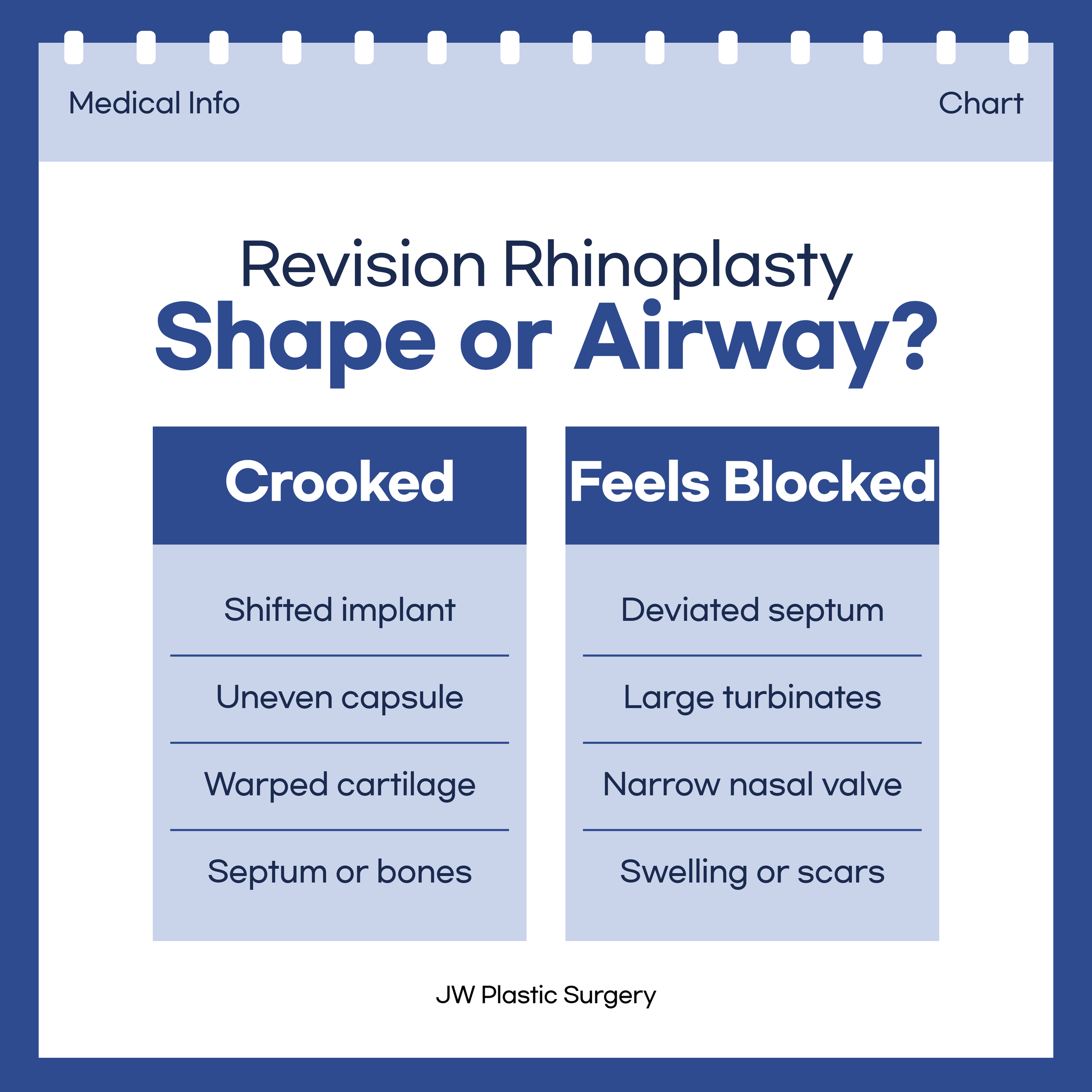
If your nose looks crooked or feels blocked after surgery, revision rhinoplasty may be an option, and the plan depends on what is behind the change. An implant that has bent, moved or started to show through the skin is one common reason to consider it.
Earlier surgery may have already affected the tissue in your nose. Your surgeon takes that into account and aims to limit further tissue damage during revision.
At your consultation, mention when each problem started and whether it has changed. Your surgeon can go over whether and when revision suits you.
Why a Nose Can Look Crooked
A nose can look crooked after surgery when an implant shifts or bends, when scar tissue tightens unevenly, when cartilage warps, or when the septum or nasal bones lean to one side. Any of these may be a reason to look into revision rhinoplasty.
| Cause | Effect |
|---|---|
| Implant | May bend, lift or shift off center |
| Capsule | Uneven tightening can pull the nose |
| Cartilage | Can warp over time |
| Septum | A bend can tilt the nose |
| Nasal bones | Asymmetry can show along the bridge |
An implant that doesn’t sit flush against your nasal bones and cartilage can lift or shift, and your nasal bridge may then look off center.
Your body usually forms a capsule (a layer of scar tissue) around a silicone implant. With a contracted nose (nasal contracture), the tissue tightens and can distort the nose. If the tightening is uneven, one side can pull more than the other.
Rib cartilage can warp (bend over time), which may change the line of your nose. The nasal septum (the wall between the two sides of your nose) and the nasal bones can also be uneven from before your earlier surgery, and that can stay visible.
Why Your Nose Can Feel Blocked
Your nose can feel blocked after surgery when the septum leans into your airway, when the turbinates are enlarged, when the nasal valve is narrow, or when swelling or scar tissue narrows the passage.
| Source | Effect |
|---|---|
| Deviated septum | Narrows one side of the airway |
| Turbinates | Enlarged ones can reduce airflow |
| Nasal valve | A pinched area can limit airflow |
| Swelling | Can block the nose during healing |
A deviated septum (a nasal septum that bends to one side) can narrow the passage on that side. Turbinates are ridges of tissue along the inner wall of your nose, and inferior turbinate hypertrophy (enlarged lower turbinates) can leave less room for air.
The nasal valve is a narrow part of the airway just inside the nostrils. If the nasal tip looks pinched, this area may be tighter too, and breathing in can feel harder.
Swelling can make your nose feel blocked while you heal, and it may ease with time. Allergic rhinitis or sinus problems can block the nose as well, and these may need a different kind of care.
How Nose Shape and Breathing Are Linked
A crooked look and a blocked nose can share a cause, mainly because the septum supports your nose and also divides your airway. When the septum bends, the outside of your nose may lean while one side of the airway narrows. So even if only the look of your nose bothers you, your breathing is worth checking too.
The two can also be unrelated. A shifted implant may change your nose line while your breathing stays the same, and enlarged turbinates may reduce airflow with no visible change.
Changing the shape of a nose can affect the airway, so planning for revision rhinoplasty can take both appearance and function into account.
How Your Nose Is Checked First
Your nose is checked with an in-person exam, and a 3D CT before surgery can show the nasal bones and the soft tissue around them.
| Check | Detail |
|---|---|
| Physical exam | Nose line, implant position, inner airway |
| 3D CT | Deviation, septum, turbinates, nasal bones |
| Morpheus 3D | 3D facial analysis and a simulated result |
During the exam, your surgeon looks at your nose line, any implant and the inside of your nose.
A 3D CT can show the shape, condition and size of the nasal bones and nearby soft tissue. That can include how far your nose deviates, whether you have a deviated septum or enlarged turbinates, whether the airway is blocked, the size and condition of the septal cartilage, and the width of the nasal bones.
A Morpheus 3D scanner can add a 3D facial analysis and a simulation of how changes might look. Actual results vary from patient to patient.
How Revision Rhinoplasty Addresses Each Cause
Revision rhinoplasty may address the implant, the cartilage, the septum or the turbinates, and these may be combined based on your goals.
| Cause | Option |
|---|---|
| Unsuitable implant | A different material or a custom 3D-printed implant |
| Implant side effects | Autologous rib cartilage, which may be diced and custom-molded |
| Deviated septum | Septoplasty |
| Enlarged turbinates | Turbinate reduction |
If an implant has shifted or bent, a material better matched to your skin may be considered. Options include silicone, Gore-Tex, ear cartilage, septal cartilage, rib cartilage and donor tissue. A custom 3D-printed implant is made from data on your own nasal bones and cartilage.
Rib cartilage is generally stronger than ear or septal cartilage, so it is often used in revision. Diced rib cartilage (taken from your own ribs) may also be shaped in a custom mold planned with CT and simulation, then used to correct the nasal bridge and nasal tip.
For a blocked nose, septoplasty (correcting a deviated septum) and turbinate reduction (reducing enlarged turbinates) may help open the airway. An endoscopic approach can give a clearer view inside the nose, which can be useful during revision.
Your surgeon can explain which approach might apply to you, along with anesthesia and recovery details, at your consultation.
📌 How a consultation works
① Concerns: You describe how your nose looks and breathes
② Exam: Your surgeon checks nose shape, implant position and airway
③ Imaging: A 3D CT or Morpheus 3D may be used as needed
④ Plan: You go over the likely cause and options
⑤ Tests: If surgery is planned, tests such as a blood test, ECG or chest X-ray may be done as needed
📍 JW Plastic Surgery clinic information
- Address 3F-7F, 553 Samseong-ro, Gangnam-gu, Seoul (Samseong Jungang Station)
- Phone +82-2-541-5114
| Item | Detail |
|---|---|
| Hours | Mon-Fri 09:00-19:00, Sat 09:00-17:00, closed Sun and holidays |
| Website | https://www.jwbeauty.com |
Frequently Asked Questions (FAQ)
Q. Can a crooked look and a blocked nose be addressed in one surgery?
A. It depends on what the exam finds. When the septum is part of both problems, your surgeon can explain whether both may be addressed during revision rhinoplasty.
Q. Is a stuffy nose normal soon after surgery?
A. Swelling can make your nose feel blocked while you heal. If it continues after swelling has gone down, it’s reasonable to have your nose checked.
Q. Will revision improve my breathing?
A. It may, if the blockage comes from a structure that can be addressed, such as the septum or turbinates. Results vary.
Q. Do I need a 3D CT if my nose only looks crooked?
A. A 3D CT can show the nasal bones, septum and soft tissue, including problems you can’t see from outside, which can help with planning.
Q. Can my nose be made completely straight?
A. Not always. Your skin, scar tissue, remaining cartilage and earlier surgery can all affect how much change is possible.
Your nose has two jobs, shaping your face and moving air, and after surgery either one can start to bother you. Knowing which structure is involved can help you decide whether revision rhinoplasty makes sense for you.
To talk through your own situation, call JW Plastic Surgery at +82-2-541-5114.