
📋 Summary
- ✅ Conclusion: If your eyes look startled or uneven after eye surgery, revision eye surgery may be an option once your surgeon has identified the cause.
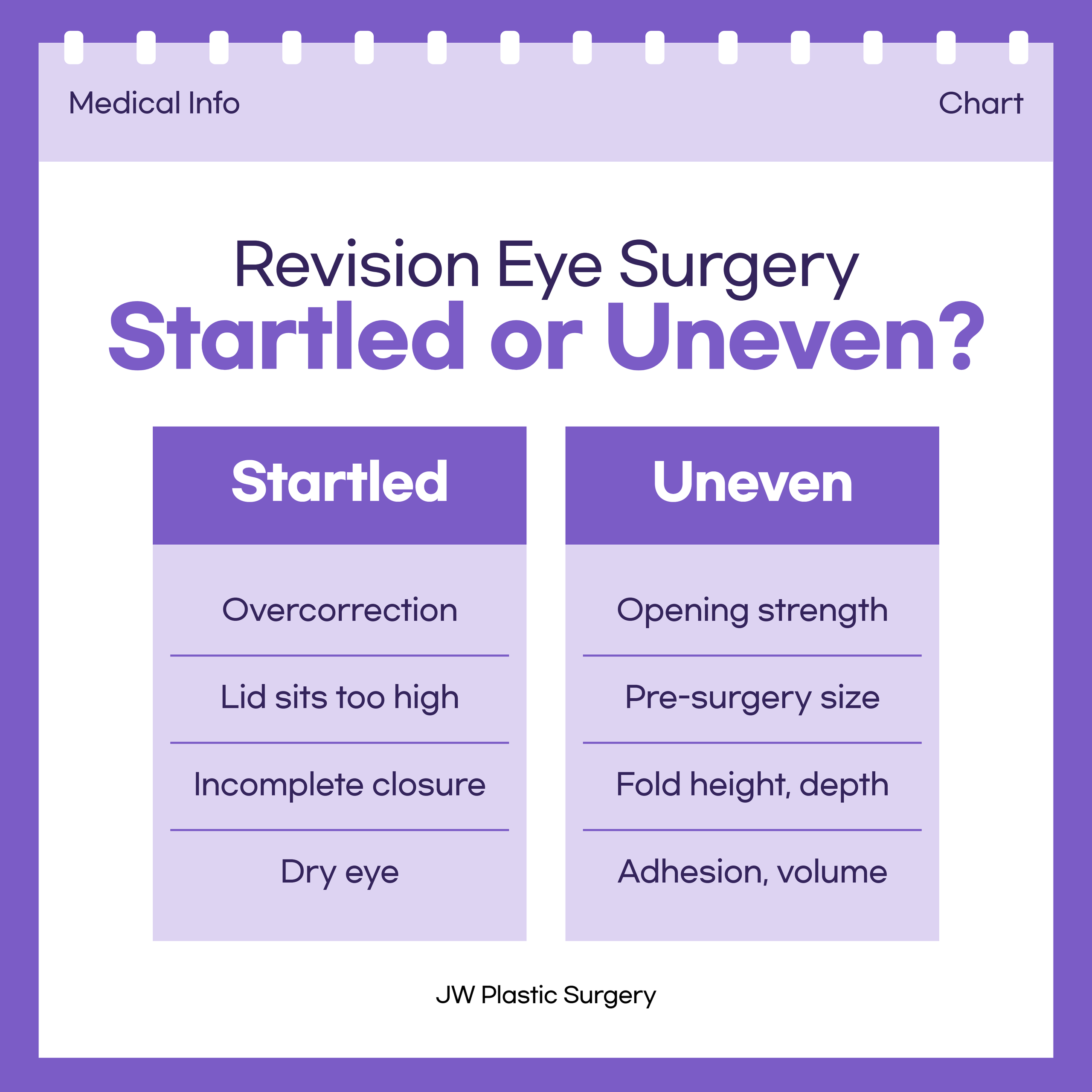
- ✅ Startled look: This can come from overcorrected ptosis (droopy eyelid), where the upper eyelid sits too high and the eye may not close fully.
- ✅ Uneven look: This can come from a difference in eye-opening strength between the two sides, and the double eyelid fold can add to it.
🔍 Questions in this article
Good to have you with us at JW Plastic Surgery in Gangnam.
You might notice it first in photos. Your eyes look wide open even when you feel relaxed, or one eye seems smaller than the other. After eye surgery, a change like that can be hard to ignore.
A startled look and an uneven look often have different causes, and revision eye surgery is planned around the cause. Below, we go through the causes, the exam, possible methods and timing.
– JW Plastic Surgery
When Revision Eye Surgery May Help
Revision eye surgery may help when your eyes look startled or uneven after surgery and your surgeon can identify what is causing it. Patients also consider it when a double eyelid has come undone, when the eye shape looks unnatural for their face, or when a functional problem has developed.
A startled look and an uneven look are separate concerns, though they can show up together. The first is about how high the upper eyelid sits when your eyes are open. The second is about how the two sides compare.
Most revision eye surgery involves several factors rather than a single problem, so the decision starts with finding out which ones apply to you. Your surgeon can tell you at your consultation whether revision looks suitable.
Why Eyes Can Look Startled
Eyes can look startled when ptosis correction has gone too far, which is called overcorrection. With your eyes open normally, the upper eyelid usually covers about 1 to 2 mm of the upper part of the iris (the colored part of the eye). If it sits higher than that, the eye can look surprised or even look like it is glaring.
| Sign | Detail |
|---|---|
| Startled look | The eyelid sits above its usual position |
| Incomplete closure | The eye may not close all the way |
| Dry eye | The eye surface can feel dry |
An eyelid that sits too high can keep the eye from closing fully, a problem called lagophthalmos. The surface of the eye then stays exposed for longer, and dry eye can follow.
When problems like these get in the way of daily life, revision eye surgery may be considered for function as well as appearance.
Why the Two Eyes Can Differ
The two eyes can look uneven when the eye-opening strength on each side isn’t in balance after surgery. Everyone has some left-right asymmetry, and opening strength is part of that, so a small difference may be natural and may not need surgery.
| Factor | Effect |
|---|---|
| Same correction, both sides | The sides can still differ afterward |
| Weaker side corrected | The other eye can look smaller |
| Fold height, depth | The fold can look different |
| Adhesion | The fold can look fixed or layered |
| Eyelid volume | The fold can look thin or too exposed |
Eyes that were the same size before surgery can end up different even after the same ptosis correction on both sides. If they were different sizes to begin with, correcting only the weaker side can make the other eye look smaller. Eye size can also depend on things other than the muscle that opens the eye.
The double eyelid fold can add to the difference. A shallow fold can disappear when you look slightly down, and a fold that has loosened can sit lower. Too much adhesion (tissue bonding where the fold forms) can hold the fold in one fixed position, while an unwanted adhesion can create a triple fold.
Eyelid volume matters too. A full eyelid can cover the fold so it looks very thin, and a thin eyelid can leave the fold too exposed.
What Does the Exam Check?
The exam checks how your eyelids sit and move, along with the height, depth, adhesion and volume of each double eyelid fold. Because a startled or uneven look can have several causes at once, these are looked at from different angles.
| Check | Detail |
|---|---|
| Eyelid position | How much of each iris is covered |
| Opening strength | How each eyelid lifts, side by side |
| Eye closure | Whether each eye closes fully |
| Fold | Height, depth, scarring and eyelid thickness |
Eyelid position is generally assessed with your eyes open and relaxed, since that’s when overcorrection tends to show. Opening strength relates to the levator muscle (the muscle that lifts the upper eyelid), and comparing the two sides can show whether balance is part of the problem.
Eye closure and any dryness help show whether there’s a functional concern. Scarring from your earlier surgery also matters, because it can affect which method is possible.
How Revision Addresses Each Cause
Revision eye surgery can lower an overcorrected eyelid, work on the balance between the two sides, or release and recreate the fold, depending on the cause.
| Cause | Method |
|---|---|
| Overcorrection | Levator separated so the eyelid can come down |
| Undercorrection | Ptosis corrected, fold released and remade |
| Excess adhesion | Adhesion released, suitable adhesion created |
| Eyelid volume | Fat or muscle removed, or fat grafting |
For overcorrection, the levator muscle may be separated from the tarsal plate (the firm tissue inside the upper eyelid) so the eyelid can come down. The gap is then bridged with eyelid tissue or a fascia graft (a piece of connective tissue). Lowering the eyelid can enlarge the fold, so the fold may also be reduced to suit you.
If ptosis remains undercorrected, correcting it can change the height or shape of the fold, so the existing fold may be released and remade. Excess adhesion may be released and replaced with a suitable one. A thick eyelid may need fat or muscle removed, while a thin eyelid may need fat grafting.
When several problems overlap, the steps are cause analysis, surgical planning and then surgery. The method varies with each problem, and results vary from patient to patient.
When Can Revision Be Done?
Revision is usually done after the tissue has settled, not as soon as you notice a change. An incised area generally needs at least 6 months before revision. In other cases, where swelling remains, about 3 months is generally advised.
Timing can differ after ptosis correction. If there’s a problem with eye height or shape, early revision within 1 to 2 weeks may be possible, depending on the situation. Once that window has passed, revision eye surgery usually waits until most of the eye tissue has stabilized, about 3 to 6 months after the earlier surgery.
Your surgeon can go over your own timing at your consultation.
📌 How a consultation works
① Listening: You describe what looks or feels different
② Exam: Your surgeon checks eyelid position, opening strength and closure
③ Fold review: Height, depth, adhesion and volume are reviewed
④ Explanation: Your surgeon explains the likely cause, possible methods and timing
⑤ Preparation: You share any medications and conditions under treatment
📍 JW Plastic Surgery clinic information
- Address 3F-7F, 553 Samseong-ro, Gangnam-gu, Seoul (Samseong Jungang Station)
- Phone +82-2-541-5114
| Item | Detail |
|---|---|
| Hours | Mon-Fri 09:00-19:00, Sat 09:00-17:00, closed Sun and holidays |
| Website | https://www.jwbeauty.com |
Frequently Asked Questions (FAQ)
Q. Is a startled look only a cosmetic concern?
A. Not always. An overcorrected eyelid can also keep the eye from closing fully and can lead to dry eye.
Q. Will my double eyelid fold change if the eyelid is lowered?
A. It can. Lowering the eyelid can enlarge the fold, so the fold may also need to be reduced.
Q. If only one eye looks off, is only that eye checked?
A. Both eyes are looked at. Correcting one side can change how the other eye looks.
Q. Can revision eye surgery make both eyes identical?
A. Identical eyes can’t be promised. Everyone has some natural asymmetry, and results vary from patient to patient.
Q. How soon after ptosis correction can revision be done?
A. In some situations, early revision may be possible within 1 to 2 weeks. After that, it usually waits until about 3 to 6 months after surgery.
Eyes that no longer look like your own can weigh on you, and wanting a clear answer is understandable. Knowing whether the cause is overcorrection, an imbalance between the two sides or the fold itself can help you decide whether revision eye surgery is right for you.
To ask about your eyes, you can reach JW Plastic Surgery at +82-2-541-5114.